
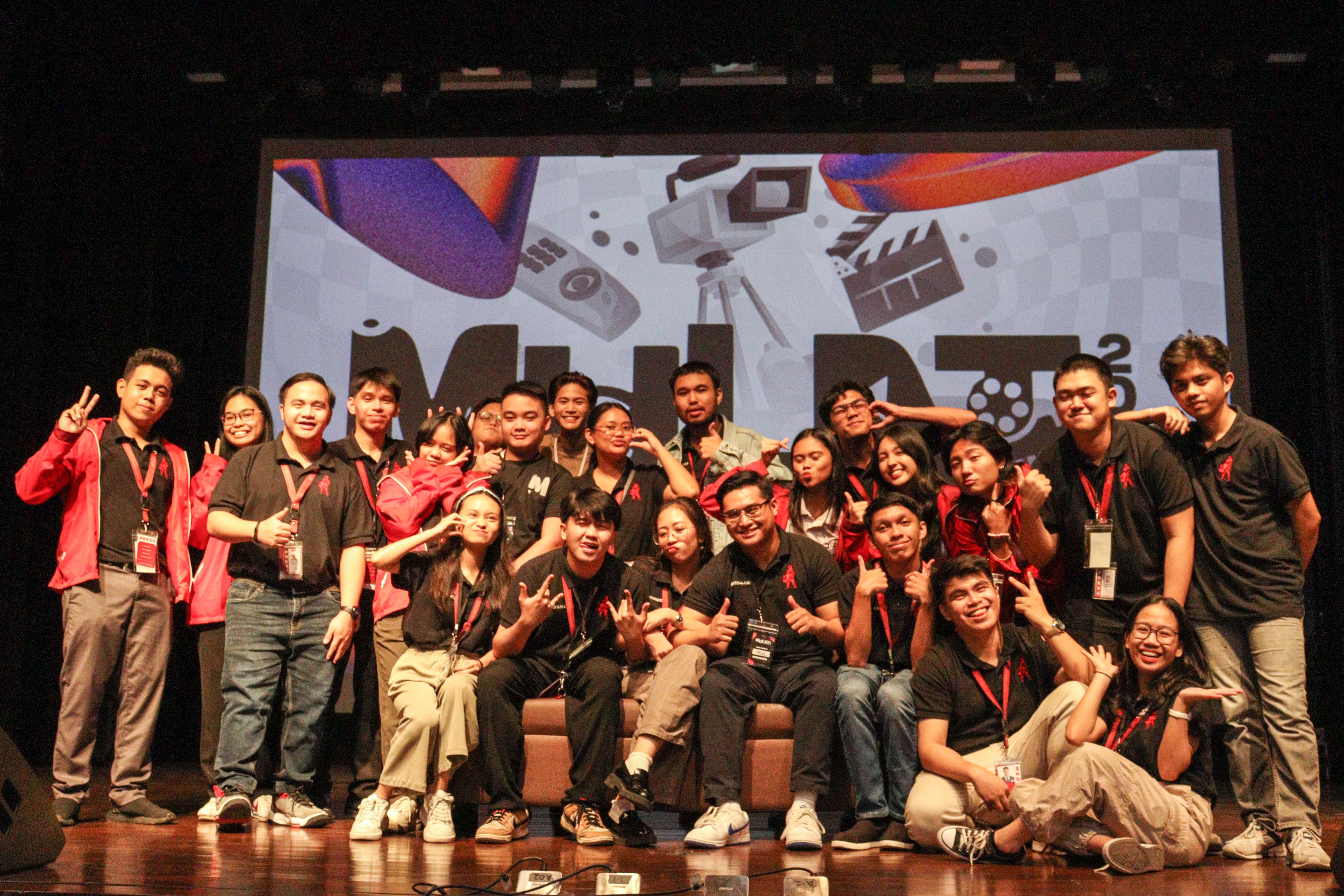
AIMING TO EQUIP student journalists with the skills to navigate the evolving landscape of 21st century multimedia journalism, The Bedan, the official student publication San Beda University (SBU) College of Arts and Sciences (CAS), staged the return of MULAT 2024 in-person at the Abbot Lopez Hall last June 7 to 8.
Embracing the theme, “Storytelling Across Mediums: Multimedia Journalism in the 21st Century,” Paul Alexis Arga, Volume 81 Editor-in-Chief, spearheaded the organization of MULAT 2024.
Reflecting on the event’s legacy, Arga recalled the challenges faced during the pandemic, particularly in 2021 when the event was last held online. At the time, despite the obstacles of distance learning, The Bedan’s Editorial Board and Staff managed to celebrate the publication’s 80th anniversary through MULAT.
This resilience, according to Arga, primarily motivated the revival of the event in a face-to-face format after a hiatus in 2022 due to the transition to face-to-face learning.
“The Bedan has a rich heritage, and we want to impart the wisdom and knowledge that we have from handling a big publication like ours,” Arga stated, emphasizing the importance of growing to the evolving demands of journalism, which now extends beyond traditional writing to encompass multimedia storytelling.
Day 1
The first day of the seminar featured prominent speakers who shared their expertise across various facets of journalism. Mr. Anjo Bagaoisan, Assignment Editor at ABS-CBN News, opened the event with a keynote address that delved into the evolution of news coverage.
Bagaoisan emphasized the “enduring” nature of storytelling, despite technological advancements and the challenges faced by media outlets like ABS-CBN.
He also underscored the role of social media as a tool for disseminating information, reminding participants of the importance of perseverance in journalism as a form of public service.
Thereafter, Mr. Raymund Villanueva, Chairperson of AlterMidya and former Editor-in-Chief of The Bedan Volume 49, offered session on the nuances of Editorial Writing.
Villanueva challenged the notion of neutrality, asserting that while journalism “must be objective and fair,” it should “not shy away from taking a stance.” He then encouraged student journalists to view their work not only as a means of reporting but also as an act of advocacy.
Participants were also given the opportunity to share their reflections. Ms. Diane Jen Baliling, a sophomore Pharmacy student from Centro Escolar University (CEU), remarked on the seminar’s emphasis on the “responsible dissemination of information,” conveying her appreciation for the discussions which resonated with her own experiences in campus journalism.
In conclusion of the first day, Engr. Arvee D. Lao talked through the history and intricacies of political cartoons. A well-crafted and effective cartoon, he emphasized, makes one think “‘Oo nga, no!’ o ‘Ba’t hindi ko ito naisip?‘”
Furthermore, underplaying, euphemism, and symbolism were some of the practical techniques Lao discussed. They play a role in subtly delivering messages that carry an impact, he stressed. It is also important, according to him, to explore diverse media forms that could enhance the delivery of messages more effectively, underscoring the evolving role of visual storytelling in modern journalism.
Day 2
The second day started with Mr. Nathaniel C. Barretto, Nation Sub-Editor at BusinessWorld, who led a discussion on news writing. During his lecture, he urged the audience to redefine what constitutes the news. Accordingly, Barretto highlighted the importance of making stories that “sell” to engage the audience through humanized perspectives and real-life examples. He practically advised aspiring journalists to “read, write, and revise” and stressed that this relentless pursuit is crucial for ensuring that information remains both truthful and authentic.
Next, Mr. Francis T.J. Ochoa, Sports Editor at Inquirer, followed with a session on sports writing. Here, he introduced the concept of categorizing stories into “Hub, Help, and Hero” content. Moreover, he provided insights in strategically approaching the publication of articles today, encouraging journalists to let curiosity guide their storytelling.
Following this, Mr. John Vincent K. Forteza, a CALABARZON 4-A regional trainer and school paper adviser, presented a unique approach to feature writing. Forteza emphasized the importance of seeking out compelling stories, stating, “What good stories don’t do is home visits. You have to go out, you have to look for them, go for it.”
Lastly, Ms. Rio Deluvio gave a session on photojournalism where she inspired participants to use their lens not just to capture moments but to ignite action. She displayed her own works in sports and other fields to demonstrate the versatility of photography as a medium. Additionally, pairing technical proficiency and creative vision can transform a photograph into a powerful narrative, hence why understanding light and mastering equipment are important.
Post-event, Arga reasoned that Multimedia became the theme because “[The Bedan] saw that multimedia really is playing a huge role in the 21st century journalism” after looking back at previous iterations of the event and similar seminars hosted by other organizations and publications. “That’s why it’s the theme that we chose, and we felt it was very, very appropriate for our time, especially in the circumstances of the Bedan,” he added, giving his regards to MULAT’s speakers, “I have to give my hats off to them.”
(with Dianne Radel Magallon)