
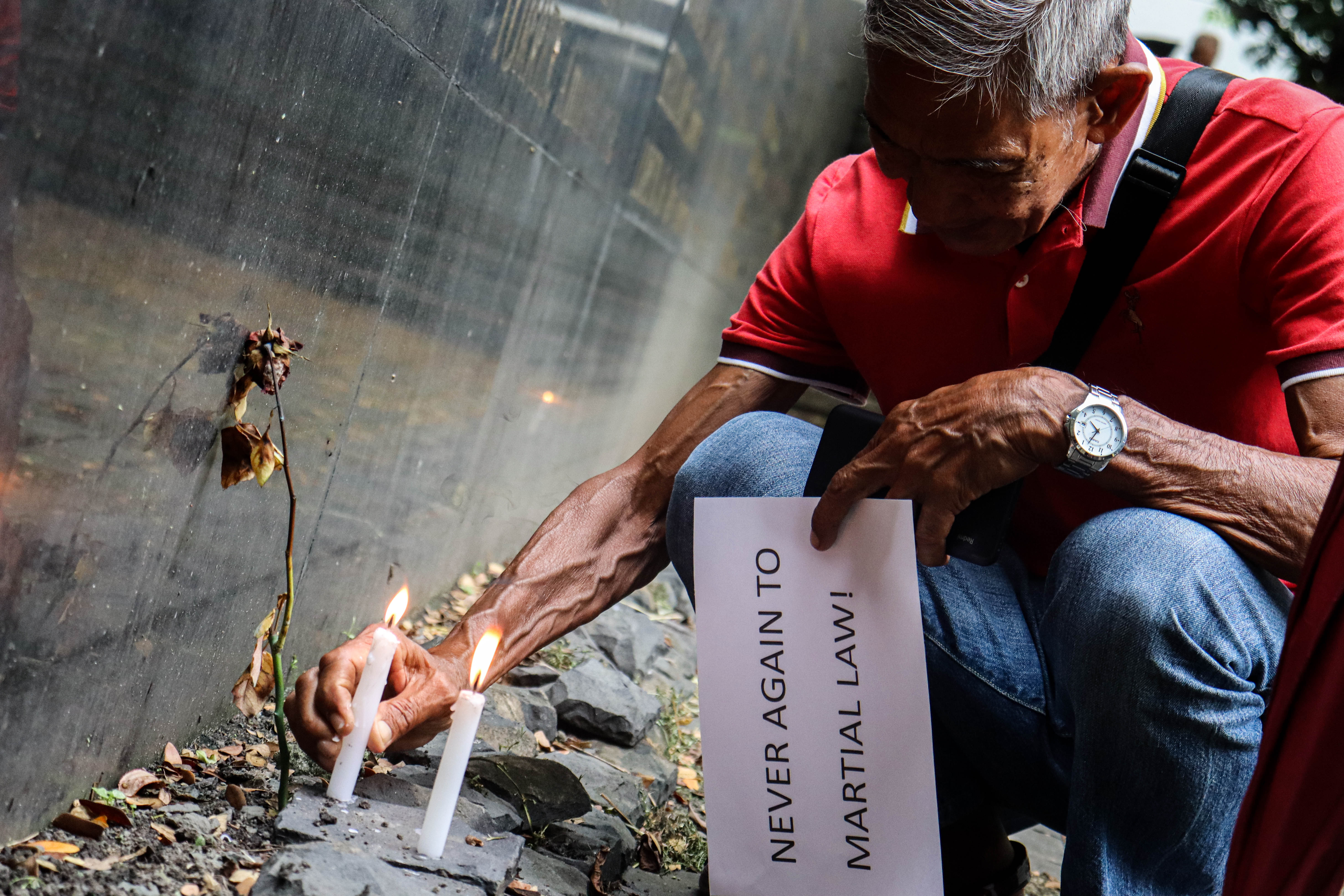
MARTIAL LAW SURVIVORS narrated accounts of torture, imprisonment and resistance during the Martial Law for the event entitled “Martial Law Noon, Ano na Ngayon?” hosted by the Bedan Advocacy and Consciousness Enhancement Society (BACES) at the Bantayog ng mga Bayani last September 27.
The roundtable discussion came as a part of the BACES tour where Bedans witnessed remnants from Martial Law such as newspapers, photographs, and Supreme Court documents featured in the Bantayog Museum. Additionally, artworks from realist artists in the likes of Gerry Roxas and Boy Dominguez were put on display in the exhibits.
Essentially, the event aimed to “foster discussions” among younger generations about the “significance of Martial Law and its lasting impact on society and combat the ongoing historical distortion about the dictatorship.”
Among the many survivors, Danilo “Danny” Dela Fuento, current Vice Chairperson of Samahan ng Ex-Detainees Laban sa Detensyon at Aresto (SELDA), narrated his life upon being arrested on February 25, 1982, where he would later be subjected to the tickling torture method called “tea party.”
Another survivor, Felix Dalisay, imprisoned from 1972-1974, narrated how he was brought to Camp Crame where he had endured severe beatings and other forms of abuse. Sid Bellica, also another survivor, shared that he suffered numerous tortures during his incarceration that caused his left ear deafness.
Compelled to activism, Nilda Fullon was initially a non-activist veterinary student arbitrarily taken into custody by the military for being a student-activist. She recalled how she was arrested after walking home from school close to a candle lighting rally, where her body would later be examined in search for supposed tattoos to “confirm” her affiliation to the Kabataang Makabayan.
Atty. Byron Bocar, an SBU graduate from the College of Law (COL), was compelled to leave the country during Martial Law after his home was raided in 1973. His friend who had welcomed him into his home later vanished, never to be found.
Although she did not go into further details about her tortures, Cristina Bawagan, a board member at the Bantayog ng mga Bayani, was also a survivor who experienced “sexual tortures during Martial Law.” She shared with Rappler how the military inserted sharp objects into her genitals and that she would keep screaming, “and it was like no one could hear” her.
Another survivor, Leonarda Tieng was initially an aspiring nun, but her life dramatically changed after she and her husband were arrested in 1974. While Tieng endured psychological and physical hardships during her detention, her husband “faced even worse,” being tortured throughout the night and enduring several beatings and even getting electric shocks known to be a torture technique called “Meralco.” This pivotal moment later propelled Tieng into activism.
Lastly, Jovito Labajo, a critique of the Marcos administration, was imprisoned because of his vocal criticisms. He later gained his freedom after the EDSA People Power Revolution in 1986.
In the official closing of the tour, both participants and Martial Law survivors held a candle lighting ceremony in honor of the 326–and counting–Martyrs and Heroes who died during the Martial Law. With their firsts up and their candles in the other, they collectively cried, “Never Again, Never Again to Martial Law!”
“This is a pilot event by BACES, particularly because we are now lenient to a more socio-political stance since parating na rin ‘yong midterm 2025 elections, and I think it’s high time na we talk about these things, that the student body talk about these things,” said Aldrich Rivera, President of BACES and activity-chairperson.
He added that “By involving the youth, especially students, the event encourages them to make informed decisions, including voting for leaders who genuinely serve the people.”
(with Paris Isaac Falcone and Myrna Ydwina Xialea Pelayo)