
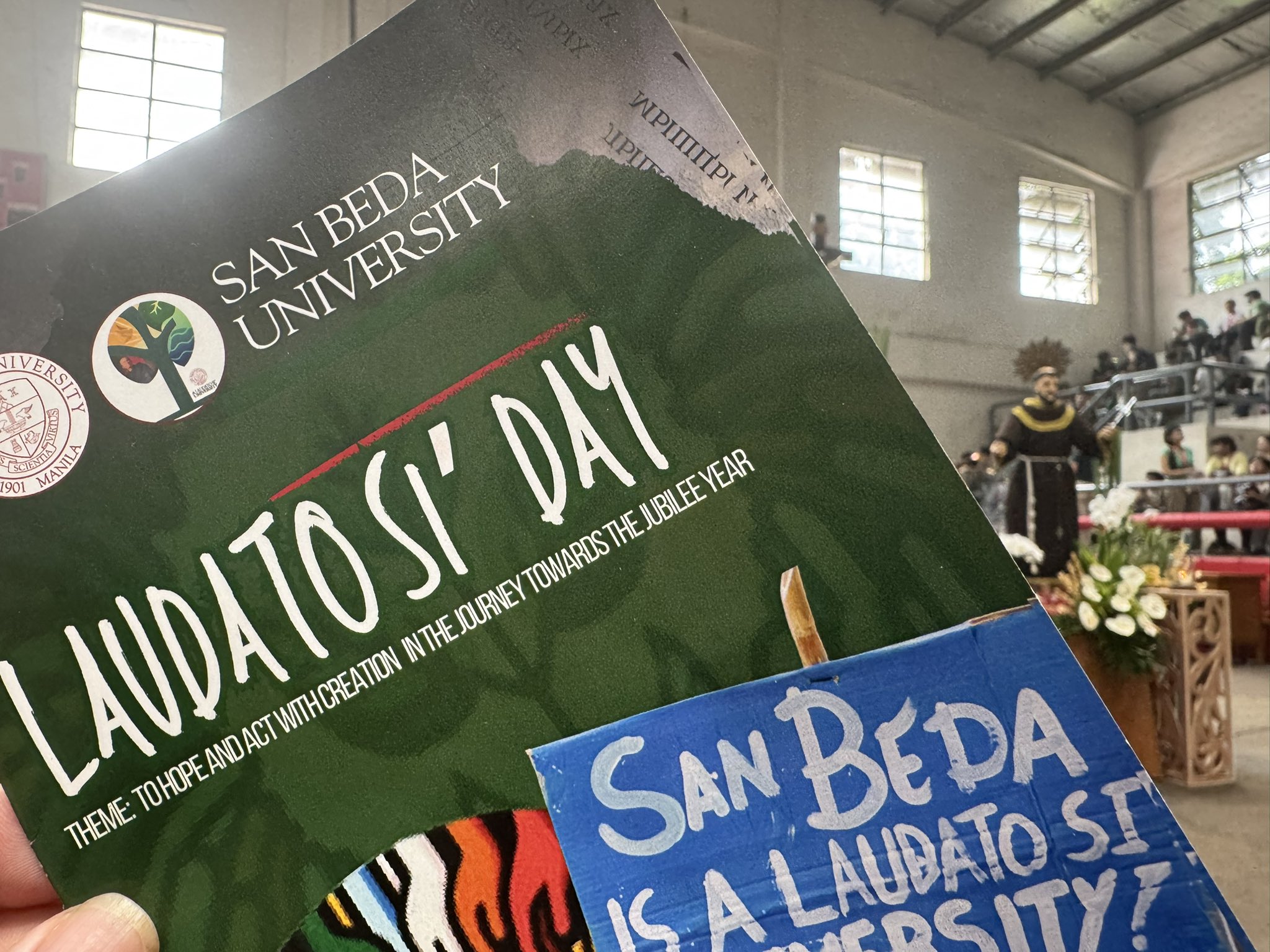
INFUSING STUDENT LEADERSHIP with the encyclical calling to provide for a common home, San Beda University (SBU) boasts organization heads who have remained committed to the Benedictine mission of stewardship, ensuring that Bedans alike are able to transform our dearest Mother Earth through innovative and sustainable solutions, thus heeding the call of Laudato Si’.
As an institution rooted in Benedictine teachings, it becomes evident that student-led organizations share a common commitment to environmental consciousness in answering the Earth’s call for sustainability.
The Bedan Advocacy and Consciousness Enhancement Society (BACES) stands at the forefront of student organizations whose resolve in meeting the Laudato Si’ mission has made it a “beacon for the papal letter on ecology.”
The organization has been met with resounding success through events such as the ‘Beda Ang Zero Waste’ wherein BACES partnered with Bambuhay, a company promoting the use of bamboo instead of single-use plastic.
Aldrich Rivera, BACES President, emphasized that the program provided for “100 bamboo toothbrushes, which were exchanged for plastic toothbrushes from students.” Thus, setting an example for future projects as “with the University’s support, students will be encouraged to organize similar activities that focus on caring for our common home.”
More recently, BACES exemplified Laudato Si’ through their College Organization Recruitment (COR) Week booth, which was made entirely from recycled materials.
Whereas, Kloie Lim, President of The Repvblic (TR), cites the role of the organization in “upholding the principles of Laudato Si’ through working closely with the Community Engagement Center (CEC).” Moreover, she underscored instances wherein “The Repvblic joined the community engagement operations sa Batangas, giving donations sa community, and advising the officers ng barangay sa Batangas to take care of the environment so they can recover sa effects ng dala ng bagyo.”
Environmental consciousness within members
One thing to keep in mind is that programs do not happen continuously. And these projects will not be met if principles aligned with sustainability are not instilled within each and every individual. Therefore, there must be conscious efforts in having the organization’s respective members participate in upholding Laudato Si.
In line with this, Rivera points towards the disasters happening throughout our country as a reminder of the importance of the ecological mission, “we’ve already witnessed just in the past few months how Typhoons Kristine and Leon have decimated the different regions of our country,” thus highlighting that members can become more involved by clearly explaining the gravity of the situation, “the longer we neglect the environmental crisis, the more dire the consequences will be.”
On the front of the Department of Legal Management, the Junior Bedan Law Circle’s Vice President for Internal Affairs, Iane Tabor, posits the great number of readings in their academic workload and how they can support the mission of Laudato Si’ through shifting to digital copies of their readings instead of opting for hardbound covers, seeing this approach as two-pronged because “makakamura na nga, tapos makakabawas pa ng carbon emissions.”
A shared goal with SBU Administrators
While the task of upholding Laudato Si’ may seem like an arduous feat, we are constantly reminded that we are not alone in this pursuit, for not only is there a great slew of student organizations, but the University’s administration itself is a constant guide and visionary in meeting this mission.
As such, Aldrich cites that earlier this year, “the OPSA gathered select organizations to provide them with ideas for possible projects related to Laudato Si’,” further noting that the University empowers its students in the ongoing effort to promote Laudato Si’ by supporting student initiatives that focus on caring for the environment.
On the side of The Repvblic, Lim stressed the role of the University in integrating Laudato Si’ in “considering the percentage ng grade ng isang organization sa Laudato Si’.”
Augmenting this, Tabor reminds us that the University, and its respective administration, helps in “maintaining the vision and direction” of the encyclical.
Furthermore, he cites the “hands-on nature” of the school. “In my time as a student leader, nakita namin ‘yung tulong ng admin when we launched the Katutubong Puno project,” highlighting the support from the Rector-President, the administrators, and the board of trustees of the San Beda College Alumni Foundation (SBCAF).
Finally, he concluded that the effort towards reaching the goal of Laudato Si’ is a joint effort by everyone, “Nakita namin na grabe ‘yung effort ng University hindi lang sa University level, ‘di lang sa org level, but it takes the whole Bedan community to make Laudato Si’ a reality.”
Seeds for a future we may never see
While the call for Laudato Si’ entails environmental protection and care for Mother Earth, for the student leaders of SBU, it may also mean planting a legacy that will carry the mission for decades, if not centuries to come.
As Rivera notes noted, “I do not want my organization to be known merely as one that champions Laudato Si’, but also as one that openly exposes the causes of the environmental crisis in the first place,” further underlining that a right to a balanced and healthful ecology is a constitutional right. He also urged Bedans to “seek to understand that one cannot advocate for something without addressing the root cause of the problem.”
Thus, calling other organizations to “follow the same principles, continue doing what you’re doing. We can’t do this alone, nor can a few organizations or groups of people. But as a collective body of organizations, I believe we can make a difference for a better environment not only for ourselves, but also for those who are yet unborn or are to come.”
With the University’s commitment to the doctrine of Laudato Si’ exemplifying how student leadership can transcend traditional boundaries, it allows the beginning of a collective pursuit of sustainability and ecological consciousness. In acknowledging the continuous efforts of the school’s organizations in taking part in this collective pursuit, we slowly witness an established demonstration of true stewardship involving, not only addressing environmental challenges, but also instilling values that resonate across generations.
(with Nityananda Santos)