
MORE OFTEN THAN not, the idea of a stardust haven is something only one sees in mere films, carrying certain themes of mysteries and wonder evoked by the complexities of the heavenly bodies. While it is all too fictional to think of a place covered under a cosmic canopy, sometimes the lines blur between reality and fantasy—such in the curious case of a town dwelling in Bohol, Philippines.
Epiphany Sunday is a celebration quite familiar to many Catholic devotees. Epiphany, in itself, means appearance or manifestation—which is what the essence of the celebration is all about—to commemorate the first manifestation of Jesus Christ to the Gentiles, represented by the Magi. As such, the celebration is also widely known as the “Three Kings’ Day,” and it is traditionally celebrated on January 6, or the first Sunday after New Year’s Day.

During which, many Roman Catholic Churches in the Philippines have their own distinct way of commemorating Christ’s revelation. But in St. Michael the Archangel Parish Church in Jagna, Bohol, the celebration is executed through its centuries-old Dagit sa mga Bitoon, meaning “Snatching of the Stars.” This follows the Padagan sa Kometa, or “Gliding of the Comet,” during which stars are suspended as part of the tradition.
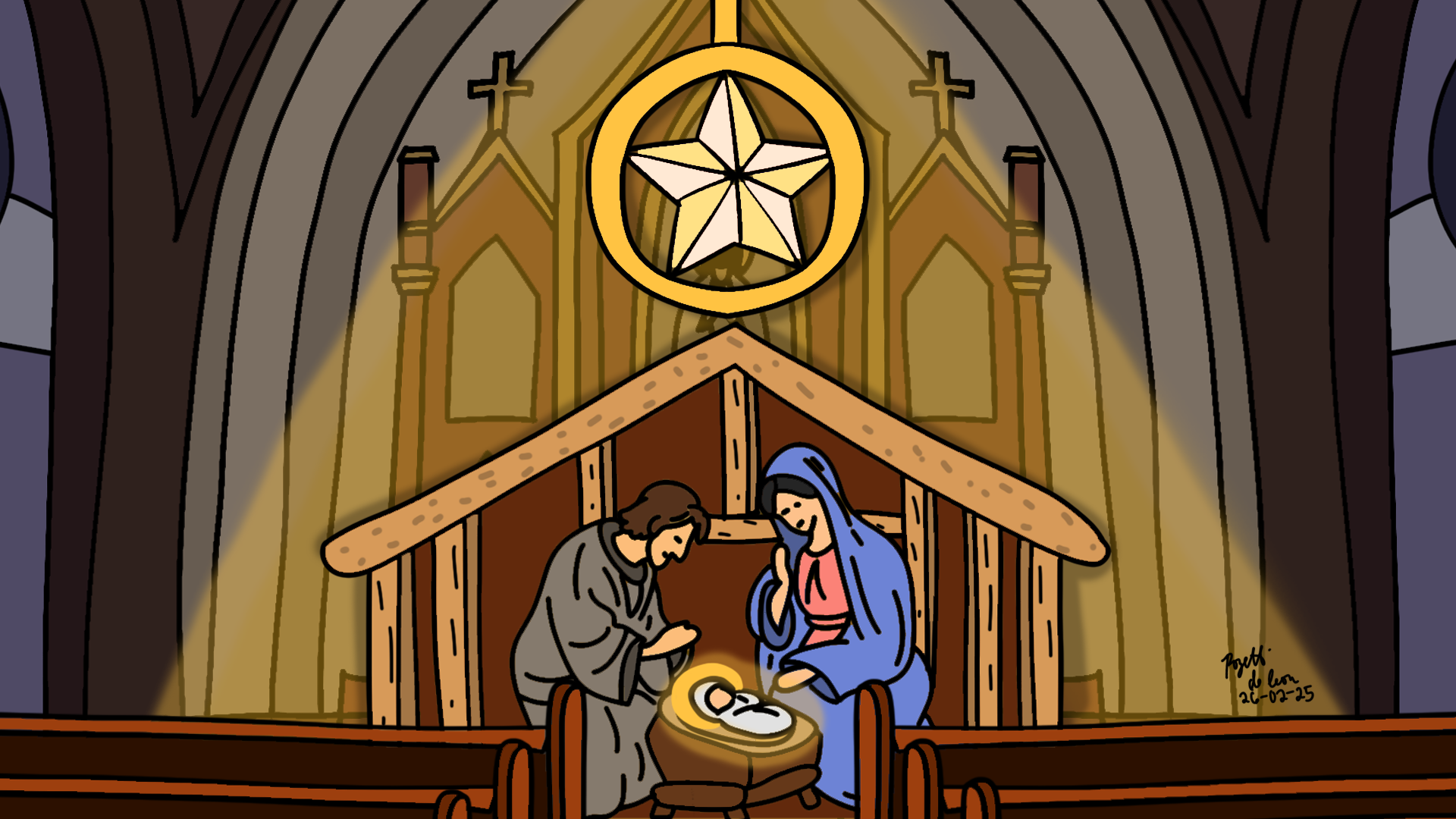
Before Christmas Eve, the nativity scene called the belen is placed near the altar with a comet or kometa hanging above it, along with several stars or bitoon of varying shapes and sizes suspended on the left and right walls inside the church.
Formerly, the church was only decorated with small stars and a small comet. But through several Christmases later, the said symbols have grown to their present uniformed shapes and sizes. The circular head of each star is over one and a half meters in diameter, with a tail that is three meters long; whereas the head and the tail of the comet are even bigger and larger. After which, the kometa is placed in the choir loft, or coro above the main gate, where it will remain until Christmas Eve ready for the Padagan sa Kometa.
Padagan sa Kometa


A combination of several long ropes and pulleys of varying slides were tied from the coro to the altar near the ceiling. Smaller ropes were connected from each start to the main line. With these ropes and pulleys, the operators maneuver the kometa to glide towards and above the belen near the altar.
During the midnight mass on Christmas Eve when the priest and choir sing the Gloria, the kometa travels alone gliding on the rope towards the belen, which is approximately 62 meters away, passing through the bitoons evenly suspended near the ceiling. When it approaches above the belen, the kometa goes down thrice to pay homage to the child Jesus. Stretching and displaying its long tail, the kometa is now in place above the belen where it will remain until the Feast of the Three Kings or Epiphany Sunday where the comets and stars are to be “snatched” during the Dagit sa mga Bitoon.
Dagit sa mga Bitoon

While the Padagan sa Kometa is also practiced in Catholic Churches in the country since it is included in the Liturgy, like in the case of Malinao, Albay with their Pascua sa Malinao (Bituon ag Kometa), the Dagit sa mga Bitoon, on the other hand, is uniquely Jagna.
Done during the recessional part of the first mass of the Epiphany Sunday, celebrated on January 6 or the first Sunday after New Year’s Day, the kometa goes down thrice, again, to seemingly bow before the altar and the belen as if to say its goodbyes to the Holy Family. After which, accompanied by a lively march by the Jagna band, the kometa begins its journey back home by gliding on the rope while snatching and carrying off each bitoon along the way.
In a homily last January 5 in celebration of the Epiphany Sunday at the St. Michael the Archangel Parish Church, Rev. Fr. Gilbert Cenia underscored the connection of the celebration to Jesus Christ, saying that, just like the stars and comets, “Jesus is the light of the world.” “He is L (love), I (intimacy), G (generosity), H (humility), and T (transformation).”
Beloved by the entire community, Padagan sa Kometa and Dagit sa mga Bitoon have endured through countless challenges and Christmases, keeping the tradition alive. In fact, Jagna prides itself for being the only town with the uninterrupted “show,” that not even the Japanese occupation nor the shift to a temporary makeshift church could ever halt such timeless practice.
Indeed, while a stardust haven is something that is carved out of pure imagination, there will always come a time where love for culture and devotion to God can transcend beyond fantasy and transform it into reality. Who would’ve thought that a town can be cradled by stars and a wandering comet—such in the curious case of a town dwelling in Bohol, Philippines.