
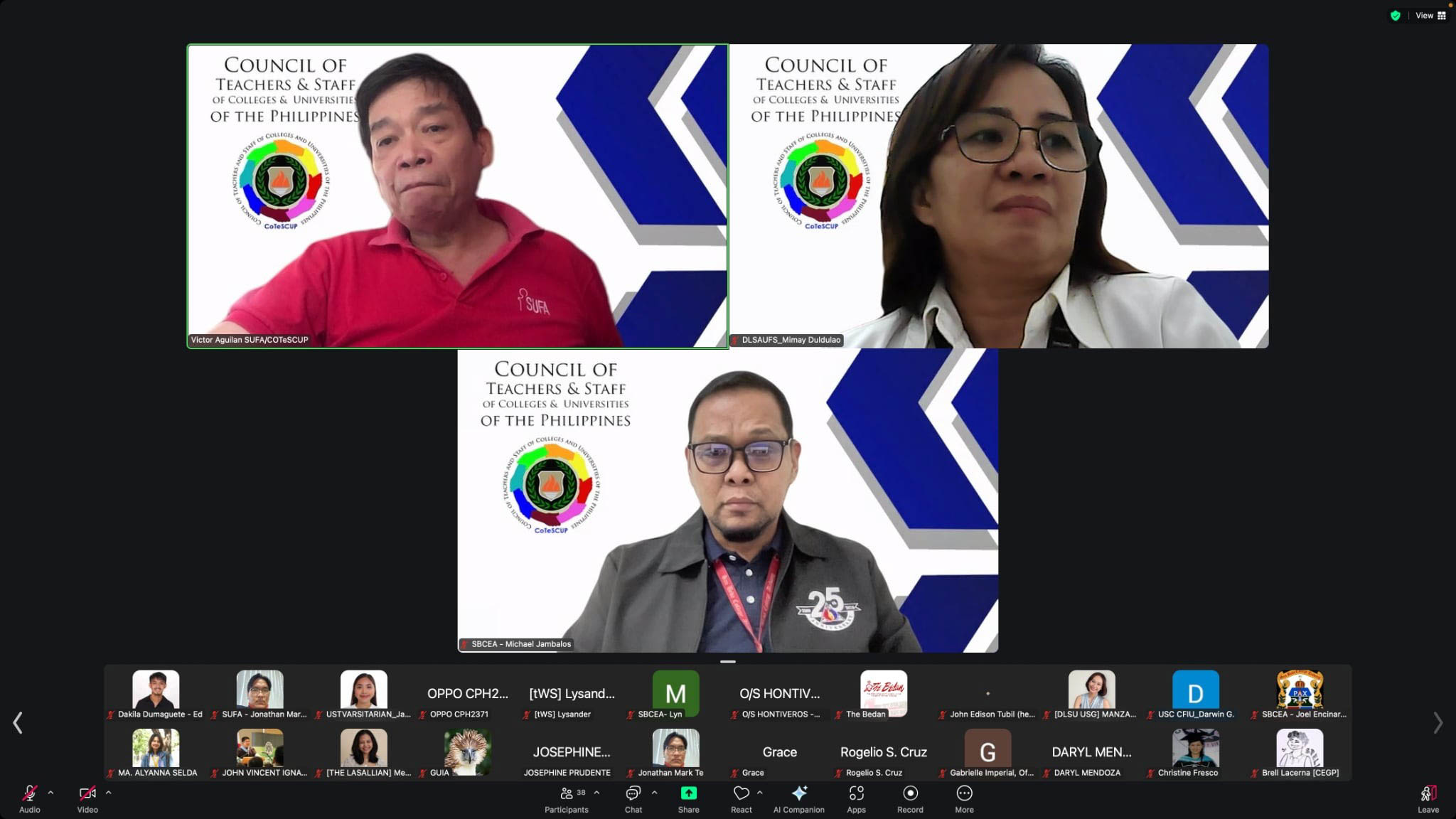
EXAMINING THE FACTORS behind rising tuition fee increases (TFI) and the lack of transparency in private educational institutions, the Council of Teachers and Staff of Colleges and Universities of the Philippines (CoTeSCUP) convened workers, union leaders, and student-journalists for an online forum with the theme Unmasking Tuition Fee Increases: A Forum on Student and Worker Rights last March 7.
Taking part in the advocacy of the largest coalition of private school unions, notable organizations such as the San Beda College Union (SBCU), San Beda College Employees Association (SBCEA), Silliman University Faculty Association (SUFA), Lyceum Faculty Association (LFA), University of Sto. Tomas Faculty Union (USTFU), Ateneo Employees and Workers Union (AEWU), and De La Salle University Employee Association (DLSUEA) participated in the event.
Their testimonies exposed shared grievances ranging from the delayed release of financial documents to the misallocation of the 70% portion of TFIs legally intended for salaries and benefits.
Student publications, including The Bedan, The Lasallian, The Varsitarian, and the College Editors Guild of the Philippines (CEGP), were also invited to the forum, playing a crucial role in amplifying the call for urgent student-worker solidarity.
Assoc. Prof. Dr. Josephine Prudente, DBA, a CoTeSCUP Board Member and former President of the San Beda College Union (SBCU), delivered her remarks framed in the context of governance and social responsibility.
“Workers and students must become informed, transparent, and engaged stakeholders,” she said, stressing the need for a collective response among stakeholders to demand accountability from their respective academic institutions and the government.
“This forum is an opportune time to convey that message, not only to our schools but to the government, so that we can shape institutional behavior and promote accountability,” Dr. Prudente asserts.
Drawing from her own experiences at San Beda University (SBU), Dr. Prudente decried the “imaginative ways” some administrations use to delay the release of audited financial statements, despite it being a legal obligation. “The law is clear,” she insisted, “but it’s not followed. Transparency in TFI allocation is often disregarded, which compromises our right to see the real financial condition of our schools.”
Using a Corporate Social Responsibility (CSR) framework, she warned of reaching a “CSR threshold,” where ignored stakeholders are pushed to act against institutions that fail to meet expectations. “When risks outweigh benefits, the school’s reputation is at stake. We’ve seen this during the pandemic—unions submitting notices of strike, campus mobilizations rising, and yet some institutions still don’t act.”
CoTesCup legal counsel, Atty. General Du, echoed these concerns through a legal lens, elaborating on how CHED Memorandum Order No. 3, s.2012 has been loosely interpreted by institutions to bypass the law.
“Some schools manipulate this guideline to include first-year students in tuition hikes, or to withhold TFI funds pending Collective Bargaining Agreements (CBA) settlements, which isn’t legally justified,” Atty. Du explained.
“The law mandates that 70% of tuition increases go to employee wages and benefits. Yet schools find ways to divert or dilute this,” Atty. Du invoked as he raised alarms over additional institutional tactics like inventing miscellaneous fees, such as laboratory, computer fees, or even those provided to varsity sports teams, to sidestep the 70% rule, thereby limiting allocations to employees.
To bring light as to why various student publications have been called, Atty. Du emphasized, “This isn’t just a faculty issue; it directly affects students. Students bear the burden of rising costs, and they deserve to know where their money is going. That’s why student participation is critical.”
With the campaign gaining momentum, the forum reinforces the need for collective action, strengthening collaboration between faculty unions and student organizations, many of which are now calling for legislative reforms to ensure fair and accessible education.
CoTeSCUP is currently working with lawmakers to introduce a bill that mandates the proper allocation of tuition fee increases and enforces institutional transparency.