
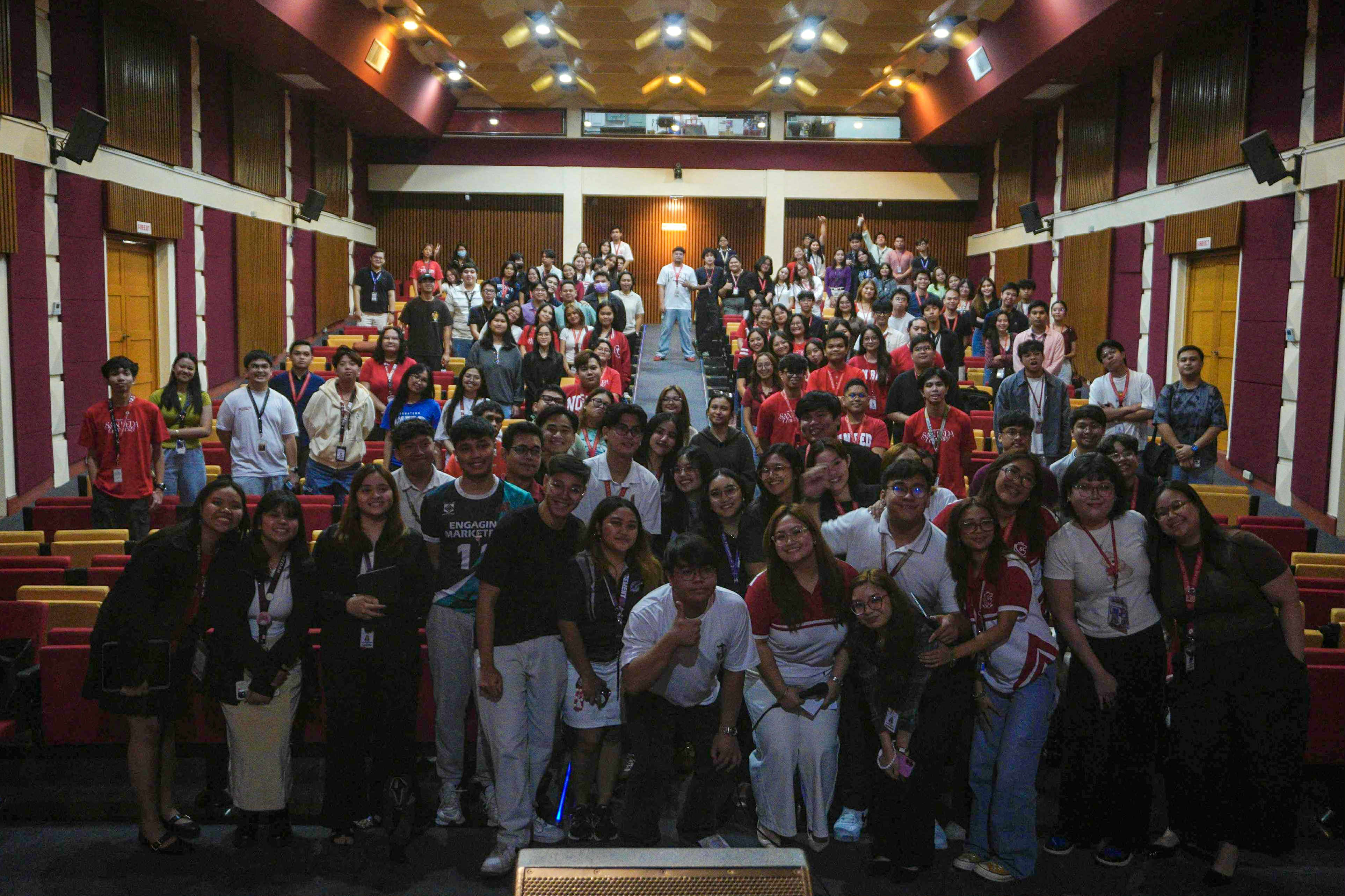
THE FIRST STUDENT Assembly (SA) of academic year 2025-2026 highlighted proposed changes to the College of Arts and Sciences (CAS) Student Council’s (SC) Constitution and Code of Discipline at the Abbot Lopez Hall last August 27, a “long-pushed” initiative in response to recent concerns affecting the student body.
In line with this, the SA focused on electing constitutional framers as the Council opened nominations for two committees—the Code of Discipline Revision Committee (CDRC) and the Deliberation Committee on the Structure of Organizations.
A long-standing bid
The initiative to revise the SC Constitution and the Student Code of Discipline was born out of long-standing calls to update student governance structures, with discussions already being lobbied during the term of former SC President Eunice Bermudez last A.Y. 2023-2024.
In recognition of the fact that several provisions set to be amended as per the discussion “no longer reflected the realities of the student body,” the Council deemed that such provisions readily called for a change.
The need for change grew even more as the establishment of the College of Accountancy and Business (CAB) took into effect, necessitating the establishment of a committee that would facilitate issues arising out of the change.
Aligning roles, strengthening accountability
Deliberations first focused on the SC Constitution, where the foregoing constitutional proposal framers of the 2023-2024 SC, namely, Faisal Armano and Bianca Valencia, presented the proposed revisions aimed at clarifying roles and strengthening accountability.
Among the proposed changes were the precise renaming of the Internal Vice President (IVP) to Vice President for Internal Affairs, the External Vice President (EVP) to Vice President for External Affairs, and the San Beda Student Council (SBSC) to CAS SC, as well as the opening of the SC Auditor position to all programs rather than restricting it to Accounting majors, in light of the creation of the CAB.
The establishment of a more defined SC committee structure was also one of the focal points that these proposals sought to set out, deviating from the outdated number of SC committees.
Additionally, changes were also proposed in the Batch Council structure, with the year-level representative serving as the ex officio chair with the power to appoint a vice chair from among the members of the Council.
Furthermore, the Assembly proposed changes to Article X on Accountability of Officers, specifically in providing detailed grounds for suspension or removal, including gross neglect of duty, misconduct, or malversation of funds, along with clear procedures for complaints, appeals, and special meetings to deliberate on such cases.
Amendments committees
Following the constitutional deliberations, the Research, Education, and Internal Communications (REIC) committee, led by Paolo Vital and Andrei John Valdez, discussed the proposed changes in the Code of Discipline, with emphasis on clarifying the provisions regarding proper attire and grooming, outside-University conduct, among others.
Under this, the addition of provisions dealing with outside-University conduct was proposed to specifically “address immoral or scandalous behavior in activities held both within and beyond campus grounds.”
Moreover, a committee was also established to address representation, considering the separation between the CAS and CAB, as the Deliberation Committee on the Structure of Organizations for the Establishment of the CAS and CAB was presented by CAS SC Secretary General, Shara Chrisly Esteba. This deliberation committee will facilitate the proposal and negotiations regarding the student organizational structure of the CAS and CAB.
The election proper
After the deliberations on the proposed changes, the election proper transpired through the assistance of the San Beda Electoral Board (ELBO). Homeroom presidents and their qualified proxies, who were eligible to cast ballots, voted in concurrence to amend the CAS SC constitution, with 74 in favor, 3 not in favor, and 3 spoiled ballots.
Ten SC constitutional framers were then elected, as the SA voted in majority upon nomination. These elected framers, along with the Executive Council (EC) members, are responsible for drafting the proposed changes to be presented to the SA, to be deliberated and approved by the EC, before ratification through a plebiscite.
Concurrently, the nomination for the committees in charge of framing amendments—the CDRC and the Deliberation Committee—are open until Wednesday, September 3, 2025.
The CDRC will be composed of a committee chairperson, CAS SC batch representatives, and 15 students from any program selected through the nomination.
On the other hand, the Deliberation Committee will be composed of one representative per publication, namely The Bedan, The Spires, and Echoes, one from the Electoral Board, and 5 representatives from the SOC, the majority of whom are from the Non-Professional Organizations.
Student welfare guaranteed
SC President Mitziko Clare Yema shared her reflections on the importance of realigning the Council’s functions, highlighting how the revisions would not only address administrative changes but also “safeguard students’ welfare by ensuring clarity and fairness in disciplinary processes.”
“It’s not about aligning it with the University’s policies but also being present and reflective of the problems students are facing,” she said.
She further expressed hope that in the years to come, the changes will undergo impact assessment to ensure that the revisions are not only retained on paper but are continuously improved in line with the evolving needs of students.
Vincent Charles Daniel Mira, one of the elected framers of the SC Constitution, emphasized the significance of such initiatives for change.
“It’s important na ma-revisit siya every now and then… very significant ngayon na na-revisit siya and very significant yung changes,” he expressed.
Mira furthered how the deliberation committee were timely and rightful for equitable representation with both clusters having their voices formally acknowledged, explaining, “We needed to ensure that CAB had its own representation in the Council.”
(with reports from Dianne Radel Magallon)