
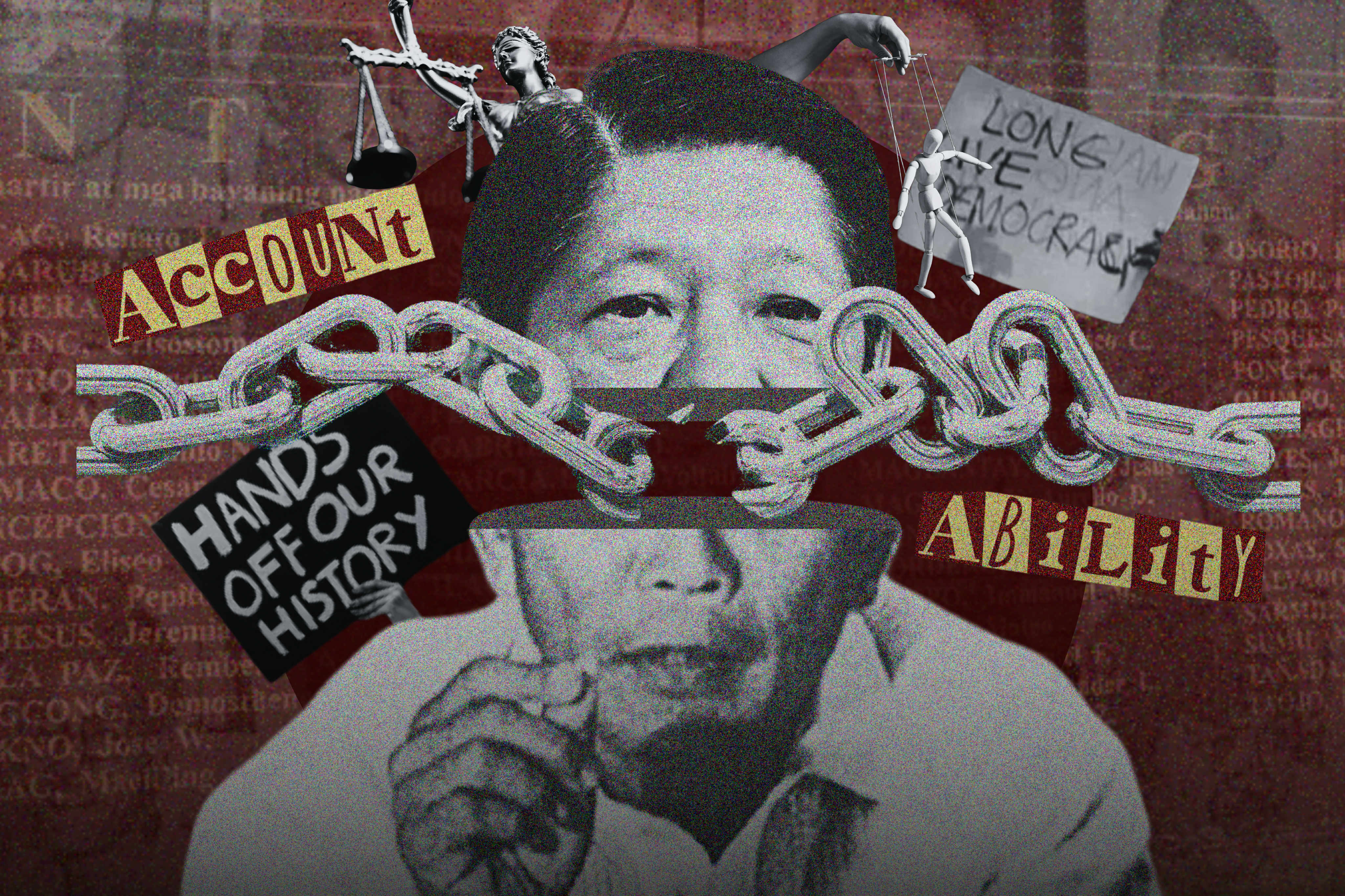
MORE THAN FIVE decades have passed since the declaration of Martial Law in 1972, a period remembered by the demarcation of bolstering human rights violations, silencing of dissent, and curtailment of democratic freedom. It was during this time that the late dictator Ferdinand Marcos Sr. destroyed democracy under his fascist regime, which ushered in a dark age of repression and unyielding control over the masses.
An estimated 70,000 people were imprisoned, 34,000 tortured, and more than 3,000 killed under the regime’s brutal order, according to Amnesty International. In our contemporary society, Martial Law is often remembered only through historical books, social media footprints, or online debates. In an age of politically nudging disinformation, what further complicates recollection are selective narratives that fanatically characterize the epoch as a ‘golden era’ for the Filipinos while sidelining the repercussions.
Such distortions not only dilute the integrity of truth but also diminish the justice and dignity that most people have been fighting for. Documented veracities, such as accounts of true survivors, tell that Martial Law was marked by systemic repression and unearthly abuse of power, abbreviating the freedom of people. The true weight of its legacy resides in suppressed stories of thousands of victims, now survivors, who continue to cry for justice and dignified recognition.
What redress cannot mend
Accountability is not measured in a single peso or mere financial remedy. The acknowledgment of lives disrupted and integrity stolen demands more than incentive restitution. Hence, the need for compensation is clear when one considers the scale and gravity of human rights abuses committed during the regime.
Families were torn apart, livelihoods were stripped away, and people carried the burden of fear and repression. Reality has proven that reparations are not charity, but a concrete response to pervasive harm inflicted by those in power.
Maria Cristina “Tina” Bawagan, an activist and long-time educator who was arrested in 1981 and experienced forms of torture and incarceration during Martial Law, continues to stand as a witness to these abuses as a staunch advocate for truth and integrity.
In an interview with The Bedan, she reflected on how the prevalent poverty amidst corruption and plunder, along with “brutality” as the “government’s means of addressing protest,” was the turning point toward her activism.
“When organizations were banned and free speech was curtailed, we found no other recourse than to work underground,” she said.
In 2013, the government enacted Republic Act No. 10368 (RA No. 10368), or the Human Rights Victims Reparation and Recognition Act, acknowledging and compensating those who “suffered grave and inhumane grievances under the dictatorship.”
From over 75,000 claims, only around 11,000 were officially recognized and granted reparations from a 10 billion fund sourced from the recovered ill-gotten wealth by the Marcoses.
Bawagan shared the significance of these government reparations as measures that were meant to restore “their honor and dignity on a national scale.”
“This law was very significant as the Philippine government itself recognized and gave compensation to the human rights victims during the dictatorship of the late Ferdinand E. Marcos,” she expressed.
Despite this being a sign of symbolic stride, many survivors have described the process of pacification as a short-term remedy, which no monetary aid could truly account for lost years and the scarring trauma.
“The recognition and monetary compensation given to those who were recognized as victims of martial law certainly helped the recipients in many ways. Nonetheless, it is important to note that RA 10368 also has as part of its provisions ‘nonmonetary reparations’—comprehensive psychosocial services, livelihood programs, educational support, and community healing. To date, these nonmonetary reparations have yet to be provided,” she said.
Memory as resistance
Recognition cannot end with checks and certificates. With historical revisionism plaguing the public sphere and outright dismissing the struggles of survivors, the helm of compensation should go beyond economic relief.
Deeper wounds come from the tainted retelling of history. Hence, social recognition plays a vital part in ensuring that their voices are heard and their truths are defended against distortion.
Beyond reopening consolations, the Human Rights Violations Victims’ Memorial Commission (HRVVMC) was also created to preserve documents, stories, and testimonies, safeguarding the memory of Martial Law atrocities.
Bawagan also emphasized the importance of this action and the role of education in catapulting such dimensions of memorialization.
“Memorialization would best be achieved by immediately and substantially incorporating [into] the curricula of the DepEd and CHED the truth about the brutality, absence of freedom, and corruption during the Marcos martial law period,” she expressed. “Lessons drawn from this experience must be inculcated in the minds of our youth.”
Bawagan stressed that this educational and awareness approach strengthens the power of these truths in “moving the nation forward and cementing their place in the nation’s collective memory.”
Resurgence and silence
Reclaiming the highest seat of power, Ferdinand “Bongbong” Marcos Jr., the son of the late dictator, is now halfway into his term. The current political climate presents a striking irony as the current president has made decisions that further intensified tensions surrounding historical memory.
Last January 2024, Malacañang issued Proclamation No. 368, removing the EDSA People Power anniversary from the list of non-working holidays and reducing it into a “special working day.” The move was defended by the administration, stating that its removal does not prevent its commemoration. Critics, however, saw it as a symbolic downgrade, an erosion of such a prominent and honored event in history.
Moreover, in September 2023, the Department of Education’s (DEPED) sparked controversy with its draft of the MATATAG curriculum, which proposed changing the term “Marcos Dictatorship” or “Diktadurang Marcos” to simply “Diktadura” or “Dictatorship” in the Grade 6 social studies curriculum.
While its framers argue that the change is purely academic and part of their internal review, educators contest that such change perpetuates risks, detaching the blame from the historical figure responsible for Martial Law abuses.
Rather than reckoning with the legacy his father left, Marcos Jr,’s rise has been driven by his narrative of redemption. He now stands as the face of current leadership while mirroring the deceptive ways of the past in the guise of progress, fueling the very machinery of disinformation that romanticizes the past.
This reality unveils the susceptibility to denial of history, where lessons written in blood and sacrifice are coated with polished agendas, amplifying the shriveled voices of those who suffered from the military rule.
This morbid memory etched into the history of our nation continues to shroud the country’s conscience and ideals. Wounds left by state repression continue to mold the lives of these people and their families.
To carve space for the stifled voices of survivors is to recognize the gravity of accountability and the duty of history, and that forgetting carries its own cost.
Forgetting is complicity rather than absence, and to yield to silence is to allow distortion to triumph over truth, and to risk the repeat of the very abuse that scarred our past.
‘Never Forget’ and ‘Never Again’ must be understood as phrases that encapsulate the spirit that refuses to allow impunity, silence, and denial to take hold once more. With blurred truths coming into place, we stand on the threshold of the blindness and oppression that once enabled authoritarian rule. These phrases are not just meant to be remembered, but to guard our memory—so that justice is not left incomplete, and silence never reigns over the voice of history.