
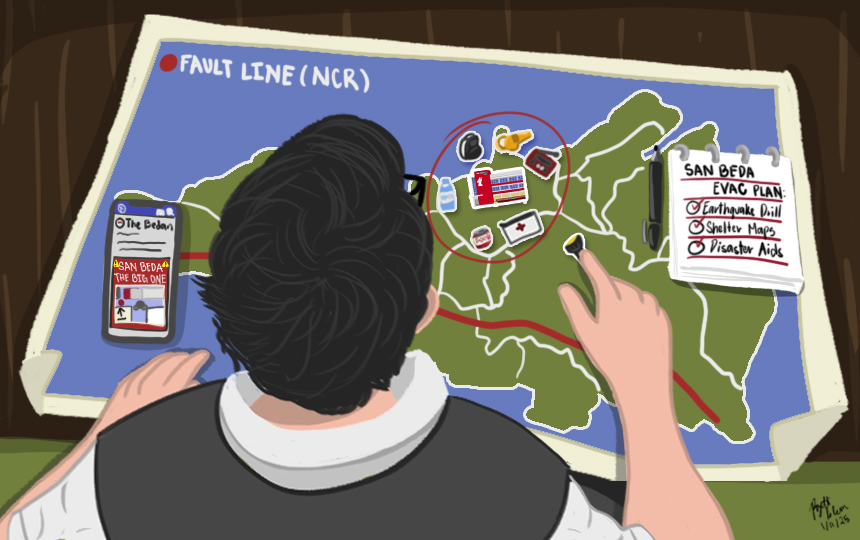
AS NATURAL CALAMITIES grow more frequent, Filipinos are yet again left to rely on “resilience,” a virtue demanded of us when our politicians fall short. But without proper preparation and coordination, such resilience is reduced to a display of a slow surrender to harsh tragedies. When tremors rippled across the country last October, shaking homes and classrooms alike, Bedans couldn’t help but wonder: how ready are we when the earth decides to move beneath our feet?
A series of earthquakes, measuring 7.4 and 6.9 in magnitudes, respectively, struck last October 2025 in the Visayan regions which left buildings damaged and families displaced, once again reminding Filipinos of the country’s fragile geography. Social media was flooded with stories of fear and uncertainty, echoing the same unease that followed the 2024 7.4 magnitude Mindanao earthquake, as well as the 2023 Davao de Oro quake series and the 2022 7.0 magnitude Abra earthquake.
Each disaster reverberated beyond its epicentre and reignited the collective anxiety of a nation living along the Pacific Ring of Fire. Yet, from these moments of uncertainty come a renewed call for preparedness. But nowhere is preparedness more crucial than in schools where thousands of students, faculty, and staff gather daily in multi-story buildings. For institutions like San Beda University (SBU), the challenge is to ensure that safety becomes not just a policy, but a moral and on our end, institutional responsibility.
Skimming through the geographics
The Philippines’ location along the Pacific Ring of Fire places it among the world’s most earthquake-prone countries. Beneath its lush mountains and bustling cities lie intersecting fault lines that can awaken without warning—among them the West Valley Fault, which experts warn could produce “The Big One,” a catastrophic earthquake capable of causing massive destruction especially in Metro Manila.
The Philippine Institute of Volcanology and Seismology (PHIVOLCS) records thousands of earthquakes each year—some barely felt, others strong enough to devastate entire provinces. In the past few years alone, major quakes have struck different regions: the 7.0 magnitude Abra earthquake (2024) that rattled Northern Luzon, the 6.8 Mindanao tremor (2025) that toppled buildings in Davao and Cotabato, and the Davao de Oro series (2023) that displaced hundreds. These recurring disasters have heightened public consciousness about the need for preparedness and resilience, especially in densely populated areas like Metro Manila.
In response, the National Disaster Risk Reduction and Management Council (NDRRMC) has intensified earthquake drills and preparedness campaigns nationwide. Schools, government offices, and private institutions regularly participate in “Shake Drill” exercises to practice evacuation procedures and emergency responses.
Campus response
Inside the University, earthquake preparedness is treated as an essential component of campus safety, reflected in its regular drills, structural assessments, and information campaigns.
For Asst. Prof. Gerard Santos, MPH, a Science, Technology and Society Professor and the Assistant Prefect of Student Discipline from the College of Arts and Sciences (CAS), regular drills remain the cornerstone of readiness. He explained that while natural disasters are unpredictable, the human response shouldn’t be.
“Kasi ang nagiging problem is, hindi alam–hindi natin alam kung ano ‘yung gagawin. Kasi ‘pag mga ganyang instances, nagpa-panic tayo…’yun ‘yung dapat na unang-una natin iniiwasan,” he added.
Prof. Santos also shared that faculty members, especially those in the sciences, try to bridge theory and application by integrating lessons on hazard awareness and environmental context. According to him, understanding one’s surroundings and local vulnerabilities is key: “Kahit sobrang layo ng lugar mo [from the epicenter], depende sa physical environment… ‘Are you located in an elevated area? Are you surrounded by many buildings?’… It can also contribute to the impact of the earthquake.”
Within the structures
Awareness, however, is only one side of readiness. The other lies beneath everyone’s feet—in the integrity of the buildings that hold the Bedan community together.
According to Engr. Jerry Basilio, the University Engineer, the institution remains “structurally sound,” with its buildings constructed under stringent standards and continuously monitored for safety.
He explained that older structures were built following earlier, highly rigid codes, which is why many of them have stood the test of time. Newer buildings, meanwhile, adhere to updated engineering guidelines under close supervision, ensuring they meet the requirements of both the National Building Code and PHIVOLCS.
Engr. Basilio emphasized that the University maintains a strong partnership with the local government in upholding these standards. Every year, local authorities conduct thorough inspections before issuing safety certifications to the campus, a process he described as both necessary and reassuring. He noted that these inspections serve not just as compliance, but as a vital form of accountability that reinforces San Beda’s commitment to student and staff safety.
Drills, too, remain an integral part of the campus routine. Basilio said that in April, San Beda conducted a joint earthquake and fire drill with observers from the Bureau of Fire Protection (BFP) and the local government. “Sinabi naman ‘yung mga kakulangan pa natin kung paano natin ma-improve. So, susunod siguro, ma-improve pa natin,” he said.
Still, he reminded that no structure, no matter how strong, can replace “preparedness and discipline.”
“Sa earthquake, kailangan lang natin talaga mag-drill para at least alam ng [lahat], hindi lang ng mga staff. Kailangan alam nating lahat kung saan tayo tatakbo o kailangan maging safe ‘yung tatakbuhan natin,” he said.
The balance between “structural integrity and human awareness,” he added, is what truly defines resilience. While codes and inspections form the foundation, it is the people who determine how well a community responds when the ground begins to move.
Awareness beyond routine
At our institution, earthquake drills have long been part of the routine—sound alarms, students move to open areas, and teachers guide them to safety. Yet, as the drills grow more familiar, questions linger on whether that familiarity still breeds readiness or complacency.
Prof. Santos emphasized that while drills are vital, they must also be “meaningful and consistent.” The problem, he shared, lies not in the lack of drills but in how seriously they are taken. “Kasi doon natin masusukat, diba, kung alam natin ‘yung gagawin natin,” he said, referring to the value of conducting unannounced drills that can truly test awareness and reaction.
He also noted that awareness should extend beyond classrooms. For him, students and faculty must know not just the steps of evacuation but also the rationale behind them—the science, the hazards, and the vulnerabilities that make preparation necessary. He pointed out that awareness itself is a form of protection.
From his perspective, drills are only one part of preparedness. The real measure lies in how well the community remembers what to do when the alarms are no longer planned.
What reality has to offer
Even with regular drills, awareness programs, and strict building standards, the truth remains that no one can predict when or how the Big One will strike. For Prof. Santos, this uncertainty is exactly why the University must prepare not just for the earthquake itself, but for what comes after.
He urged “consistency and inclusivity” in the conduct of earthquake drills, noting that the hybrid setup sometimes limits participation. For him, unannounced and varied-schedule drills ensure that every student, regardless of their class modality, experiences what to do in real-time.
He also called attention to the aftermath of disasters—an aspect he believes is often overlooked. He explained that true readiness must go beyond the few seconds of shaking.
“Ang piniprepare kasi natin yung ‘during’, pero pag sinabi mo kasing ‘yung Big One, like… ‘yung nangyayari sa ibang bansa, talagang total destruction,” he said, warning that outages, water shortages, and communication breakdowns could cause chaos if not accounted.
For this, he suggested that the University must establish “clear post-disaster policies” that address how classes, coordination, and communication will continue in the event of prolonged disruptions. He pointed out that the pandemic already proved how unexpected situations can paralyze institutions unprepared for continuity. Such systems, he said, could make all the difference in preventing confusion and maintaining order when normal routines collapse.
In the end, both such perspectives converge on a shared truth: preparedness is not just an institutional responsibility—it is a collective mindset. The University may strengthen its walls and refine its systems, but it is the awareness, cooperation, and discipline of its community that will determine how it endures the unexpected.
Beyond drills and inspections, both professionals agreed that awareness and consistency are the real keys to preparedness. As Prof. Santos emphasized, “…At the end of the day, nasa mga tao pa rin ‘yan on how they will behave, on how they will act.”
(with Nicko Gabriel Dela Vega and Bianca Ashley Bitanga)