
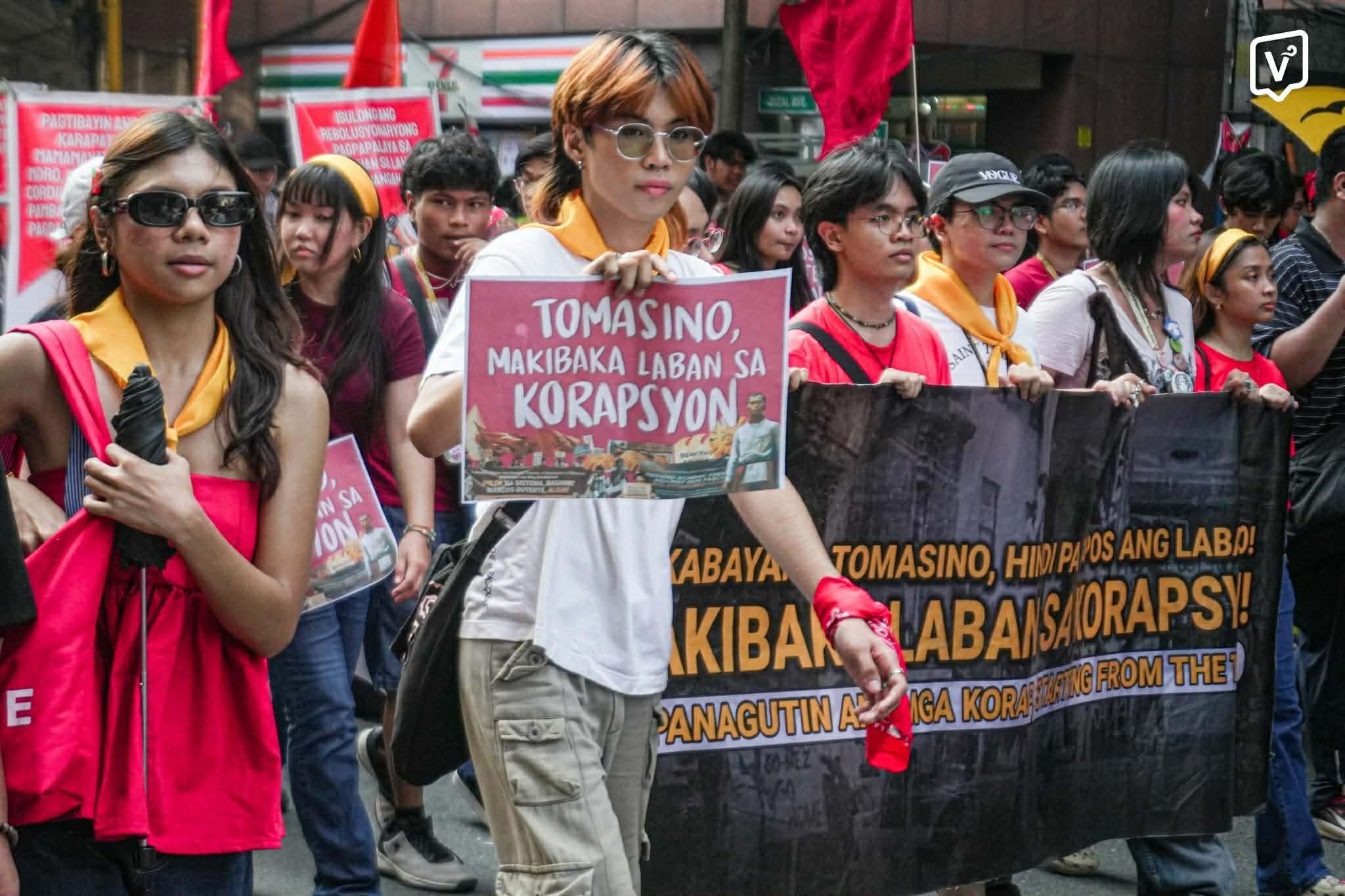
AS CHRISTMAS CAROLS echo through brightly lit streets and homes filled with celebrations, youth activists mark Christmas not only with songs and traditions but also with a sharpened conscience that refuses to ignore the crises deepened by corruption and injustice.
Across the country, the recent wave of protests reflects the frustrations and hopes of communities long burdened by social injustices, such as corruption and poverty. Fueled by the values of compassion and righteousness, the people, especially youth activists, continue to sing a carol that advocates moral courage and societal justice.
With that, Filipinos enter a Christmas season of reflection and resolve and a time to take stock of the year’s lessons and make the most of the remaining days to push for tangible reform before 2026 begins.
Christmas sparks collective and unified action
This Christmas season has arrived with a scene that is shaped by months of protests and civic action, reminding society that empathy and awareness must go beyond celebrations and into meaningful action. As Ray Manuel of Kabataan UST Artlets puts it, making society “more empathetic towards the vulnerable.”
This surge of activism also demonstrates the capacity of mass movements, especially youth-led actions, to shine light on societal inequities.
“Even ‘yung mga regular people na hindi naman ganun ka-active in terms of politics o kaya in terms of these kinds of movements, it really shows a lot na parang punong-puno na ‘yung masa,” he said.
Similarly, youth activists have emerged as a critical force in sustaining these movements. Ray notes, “sila lang din ‘yung magpapatuloy ng mga kilusan,” actively bridging gaps between various sectors of society and amplifying the voices of marginalized communities through youth activism.
The ongoing protests have brought accountability in governance to the fore, mirroring Filipinos’ mounting concern over worsening injustice, which Ray says must be confronted to address the root cause.
“Gusto nating paingayin nga talaga ‘yung issue lalo para humingi nga ng accountability [na] pananagutan. And para mag-step down na nga talaga kung sino nga ba talaga ‘yung mga sangkot, sino nga ba talaga ‘yung ugat ng problema,” he said.
In addition, Christian values of compassion and righteousness provide additional grounding for civic engagement, reminding citizens that empathy is central to Filipino identity.
This connection between ethical values and social action strengthens solidarity, particularly during a season culturally associated with generosity and collective care.
Ultimately, the lesson from this season of activism is that awareness without action is insufficient, as Ray’s reflection captures this imperative clearly: “Mulat na nga tayong mga kabataan, pero saan mapupunta yung kamulatan natin kung hindi tayo tumutulong sa masang anakpawis?”
The nation’s cry amidst the holidays
Meanwhile, Elisha Vaughn Manangbao, a third-year BS Psychology student and Governor of the College Student Council of the School of Arts and Sciences (CSC-SAS) at Holy Angel University (HAU) in Pampanga, believes that people are becoming more aware of their political stance, starting to understand their right to protest.
For Elisha, Filipinos have long been aware of the prevalence of corruption in the Philippines. However, the sheer scale of the recent flood control scandal has sparked massive outcry across regions, culminating in continuous mobilizations—something he views as a “good sign.”
“A lot of the people are being more engaged to go outside of their homes to protest. And I think that’s a good sign because that shows that our society is becoming more keen on the people [in] power and are more critical of who should be seated,” said Elisha.
Moreover, he indicates that the critique that protesters often get is whether rallying is effective, pointing out that shouts and being angry on the streets for a day do not miraculously force the government to change the following day.
Nevertheless, Elisha remarks: “protests are really one of the first steps to making these individuals [non-protesters] that we have the capabilities or we have the ambition to change what’s wrong.”
He further expounds that embodying the value of compassion is one’s care, regardless of whether they are privileged.
“A lot of us weren’t affected, but we still wanted to show people that, yon nga, the community, like driven Filipinos, they’ll stand up for one another. We’ll stand up for each other. And it may not be like my problem, but it is a problem of the community around me,” said Elisha.
Nonetheless, he believes that activism and its effect start to die when people choose silence. Hence, he hopes and encourages people to still create noise regardless of the holiday, putting greater pressure on the government to take palpable action against corruption.
Season of compassion
For Alecx Ymson, chairperson of Anakbayan FEU, the Christmas season sharpens the demand for accountability.
He emphasized that true compassion means “refusing to ignore suffering caused by corruption, especially when stolen public funds translate into hunger, displacement, and deaths during the holiday season.”
Alecx added that Christmas is not only a time for celebration and festivity but also a “time for reflection,” saying that people must remain mindful of communities suffering from corruption, poverty, unemployment, low wages, and other social injustices.
“…ang Pasko rin ay hindi lamang panahon ng pagdiriwang, hindi lamang siya panahon ng bakasyon, kung hindi panahon din siya ng pagsusuri. Dahil habang nangyayari ang Pasko siguro, habang nagdiriwang tayo, nagcecelebrate tayo, may mga komunidad din na patuloy na nagdurusa,” he said.
For Alecx, protests should not end with a single moment or remain episodic. Rather, they must serve as the beginning of a broader awakening among the youth, emphasizing that sustained action and growing political awareness are “essential in pushing for accountability and lasting change.”
This Christmas, the lessons of recent protests, youth involvement, and the values of compassion urge society to see empathy not merely as sentiment but as a call to action. And the festive Christmas season thus becomes a reminder that social justice is ongoing, that the collective struggle for accountability and equity requires sustained participation, and the moral responsibility to act does not end with awareness—it should and will continue in every decision, every campaign, and every effort to uplift the vulnerable until achieved.
Ultimately, for these youth activists, Christmas is more than lights and songs. It is a reminder that compassion requires action, and that justice must remain at the heart of celebration. The spirit of the season endures when it inspires hope, accountability, and real progress.
(with Eunice Karen Buccat)