
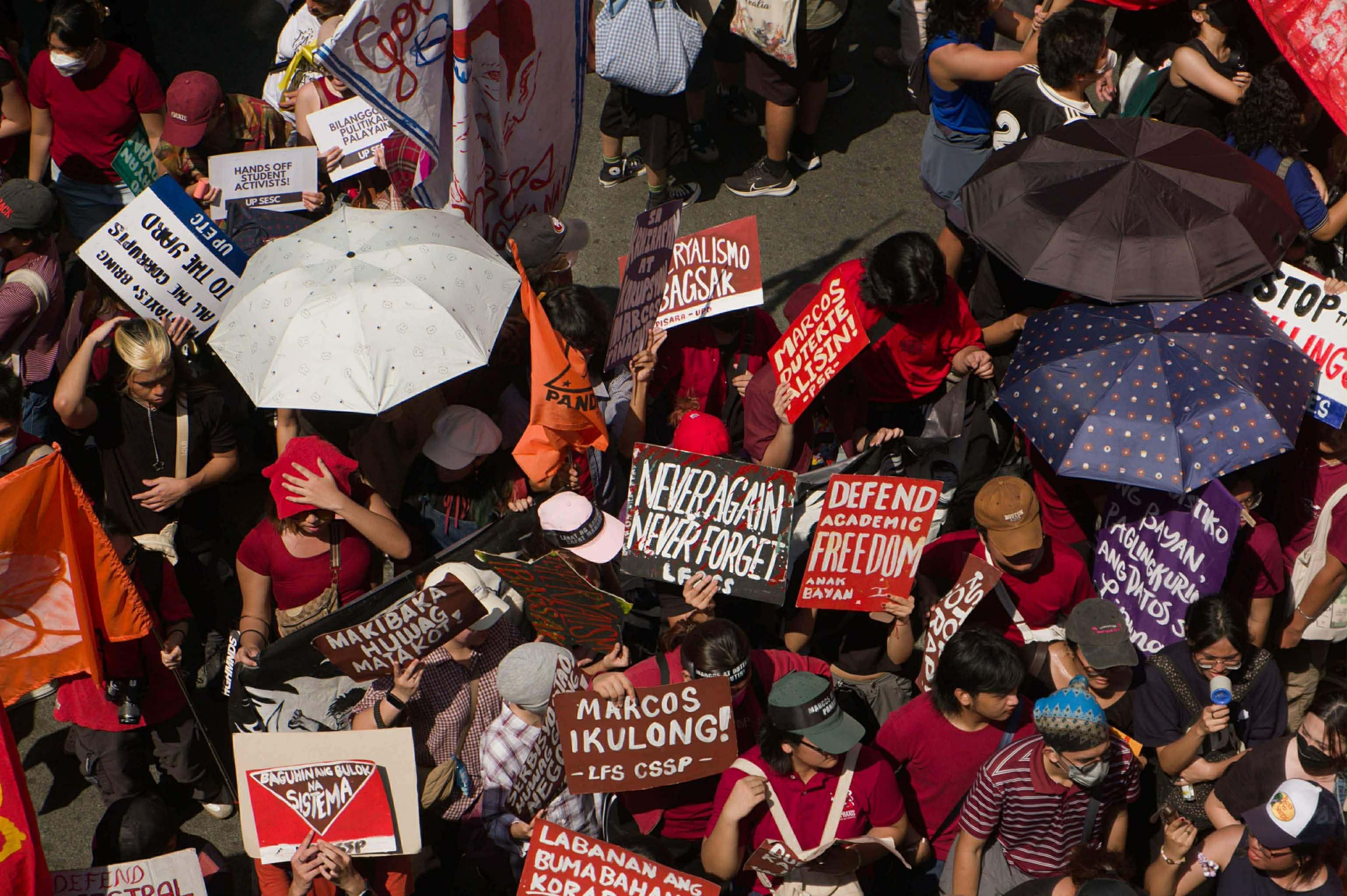
YOUTH AND CIVIC groups returned to the streets on February 25 to commemorate the 40th anniversary of the EDSA People Power Revolution, staging protests against the continued dominance of political dynasties and systemic corruption within the government.
The day’s events unfolded through two major mobilizations: civil society groups under the Trillion Peso March Movement organized the “Trillion Peso March Part 3” at the People Power Monument, while progressive organizations under the EDSA40 Alliance marched toward the EDSA Shrine.
Thousands, including religious organizations, labor unions, and students, eventually converged at the Ortigas intersection.
The program took place amid heightened tension after Malacañang designated the anniversary as a special working holiday. Critics saw the move as an attempt to “downplay the revolution’s historical weight, but the administration defended the designation.
Palace Press Officer Undersecretary Atty. Claire Castro stated in a press briefing that the events of 1986 remain an indelible part of the national consciousness despite the change in holiday status: “It’s part of history, hindi ito mabubura,” she added.
Leodegario “Ka Leody” de Guzman, National President of the Partido Lakas ng Masa (PLM), condemned the declaration as a desecration of the people’s power, while Atty. Antonio “Tony” La Viña labeled the shift as revisionism.
“We have to push back on that,” Atty. La Viña stated, emphasizing that collective memory is not state-dependent. “We don’t need a holiday to remember on our own.”
For De Guzman, the protest was a necessary response to what he described as the country’s regression since 1986. He cited the ballooning national debt, now at Php 17 trillion, and a tax system that burdens even the poorest through Value Added Tax (VAT).
He also noted that while 1986 saw the end of one family’s dictatorship, it has been replaced by a “dictatorship of the elite” that excludes workers, farmers, and students from true democracy, calling for the immediate passage of an Anti-Political Dynasty Law, arguing that the current Congress would never pass a bill that threatens its own power.
Between these calls for accountability, various organizations showcased cultural performances including street theater and music that linked the socio-political struggles of 1986 to modern-day demands for transparency.
The mobilization also featured a lineup of prominent speakers, including Mamamayang Liberal (ML) Representative Leila de Lima, who delivered a sharp message on active citizenship. In her speech, De Lima emphasized that Filipinos must live out the spirit of EDSA and held that both the Marcos and Duterte administrations must face accountability. “Managot lahat ng dapat managot,” she declared.
Atty. La Viña further noted that the gathering was about fulfilling the promise of EDSA—a promise of democracy and good governance that he believes has yet to be realized.
“Forty years after, we’re still fighting,” he said. “We should not give up hope, especially because of the young people. All the people here, most of them are very young.”
Consistent with Atty. La Viña’s observation, student groups and youth organizations comprised a significant portion of the mobilization’s leadership. For Alvin Aligam, President of the Polytechnic University of the Philippines (PUP) College of Communication Student Council, the anniversary was a platform to critique a perceived lack of systemic progress.
He highlighted specific student grievances, such as low education funding and the ongoing struggle for campus press freedom, as direct parallels to the struggles of the 1980s.
Aligam criticized the government’s use of “special working days” and asynchronous classes at PUP as strategic barriers to student activism.
However, he maintained that the need for collective action surpasses academic requirements.
“Dapat talaga na gawin natin ay kumilos, lumabas sa mga classroom at tumungo sa lansangan dahil dito, tunay nating maaral ang lipunan,” he quipped.
Amidst the deployment of nearly 15,000 Philippine National Police (PNP) personnel, Aligam argued that methods of state control have evolved rather than disappeared.
Pointing to the police cordons surrounding the EDSA Shrine, Aligam characterized the youth’s presence not just as a commemorative act, but as a manifestation of the current state of democracy, questioning the actual state of political rights.
An estimated 8,570 participants attended the activities in key areas around EDSA, the National Capital Region Police Office (NCRPO) reported.
(with Catherine Botalon)