
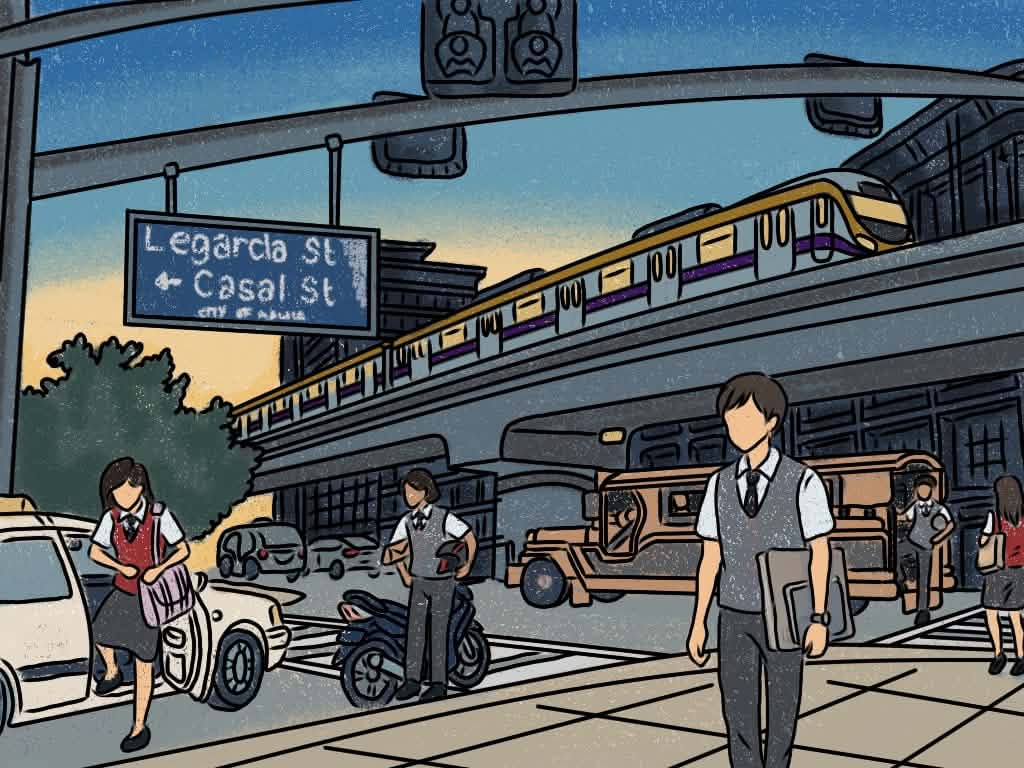
IT ALL STARTS when the sound of the alarm clock suddenly goes off at five in the morning, still feeling drowsy while also being tempted to pick up the phone and doomscroll all over social media. However, the temptations are halted as the urge to get up and prepare for the turbulent world out there becomes apparent with the clock ticking, indicating that every second that passes means the streets are slowly being filled with traffic and the rails brims of commuters.
One of the notions of university life generally seeks long-awaited independence, such as being able to navigate through the metropolis to make it to the college, thus earning a sense of accomplishment. While the concept can be gratifying, this, however, bears a hurdle that questions a daydream that one wishes.
Commuting by train, jeepney, busses, tricycle, or motorcycle taxi, having the idea of witnessing a panorama of wonders, leads one to believe that the journey to campus is not so bad after all. However, this seemingly ideal picture is only one side of the story.
For many students, the reality of the daily commute differs greatly from what they had envisioned.
Lifeline of Filipino commuters
Born from the ruins of World War II, this mode of transport became more than just a means of getting around the community; it became part of Filipino culture. Jeepneys carry the Filipino people, bringing them together in one small space as they head to their destination.
By no means is the jeepney solely a mode of transportation for workers; it also carries students through the city’s busy streets, each hoping to arrive in class on time despite the uncertainties of the daily commute. While its shared space brings people together, that same closeness can also give rise to overcrowding and discomfort experienced by its passengers.
Behind every jeepney ride is a student chasing more than just punctuality. Amid the crowded seats, fluctuating weather conditions, and unpredictable traffic, they carry heavy bags, unfinished readings, and aspirations for a better future.
With every fare paid and every stop passed, the daily commute becomes more than a routine—it becomes the first lesson of the day. Experiencing patience, resilience, and perseverance serves as a reality check that education extends beyond the four walls of the classroom.
Canned panorama
Along the busy highway, the pillars standing in the middle, escaping the cruelty of traffic, hold not only a railway and its vehicles, but also the dreams and future of millions of Filipinos. The Light Rail Transit (LRT) and the Metro Rail Transit (MRT) are the carriages that transport workers and students to their workplaces and campuses.
Riding the LRT and MRT has helped students travel across the city while avoiding the traffic brought by rush hour. For many Bedans traveling on the LRT-2, the pre-recorded announcement, “Paparating na sa Legarda Station,” has become music to the ears because the station is situated right beside the campus of San Beda University (SBU).
The presence of trains in the city has provided satiation to students by offering a panoramic view of the urban landscape while providing convenience and reliable transportation, especially for those living independently or those who came from the province. At its core, there should not be any problem regardless of where a person comes from, as public transportation is meant to serve everyone equally; however, that is not always the reality for many commuters.
As rush hour arrives, the train transforms into what may be comparable to a can of sardines, with passengers packed shoulder to shoulder and barely enough room to move, leaving little to no personal space. Instead of serving as a moment to rest, recharge, or prepare for the day ahead, the commute itself becomes an exhausting experience that drains passengers before they even reach their destinations.
What should be an ordinary trip often turns into a daily struggle marked by long queues, delayed departures, and the uncertainty of whether another train will have enough room. For students, arriving at school already exhausted makes it more difficult to stay attentive in class, while workers begin their shifts with diminished energy.
Every commute should be an opportunity to prepare for the day ahead, not an exhausting struggle before classes even begin. Yet amid the crowded train cars, students are reminded that they are not alone, as every passenger is traveling toward a dream of their own.
Weaving two-wheels
Motorcycle taxi services such as Angkas, JoyRide, and Move-It have become a reliable mode of transportation for students traveling to and from their campuses. With the ability to weave through heavy traffic, these services provide a faster alternative to traditional public transportation, especially in a city where congestion has become part of daily life.
Despite their convenience, motorcycle taxis come with unavoidable drawbacks that students must face during every ride. Passengers remain exposed to the scorching heat of the sun, inhale polluted air from surrounding vehicles, and are more vulnerable to road accidents than those traveling in enclosed forms of transportation.
Even with these risks, many students continue to rely on motorcycle taxis because they offer a quick and efficient way to reach school on time. In a fast-paced city where every minute counts, arriving at their destination promptly often outweighs the discomforts and dangers encountered along the journey.
While motorcycle taxis are more affordable than conventional taxi services, they remain considerably more expensive than traditional modes of public transportation such as jeepneys, buses, and trains. For many students, choosing speed and convenience often comes at the cost of a larger portion of their daily allowance, making every ride a careful balance between saving time and managing limited expenses.
Every commute tells a story of sacrifice, whether aboard crowded trains, packed jeepneys, or costly motorcycle rides, all while making every peso count. At the end of each journey are students simply maneuvering through the city with nothing more than a coin purse and a dream.