
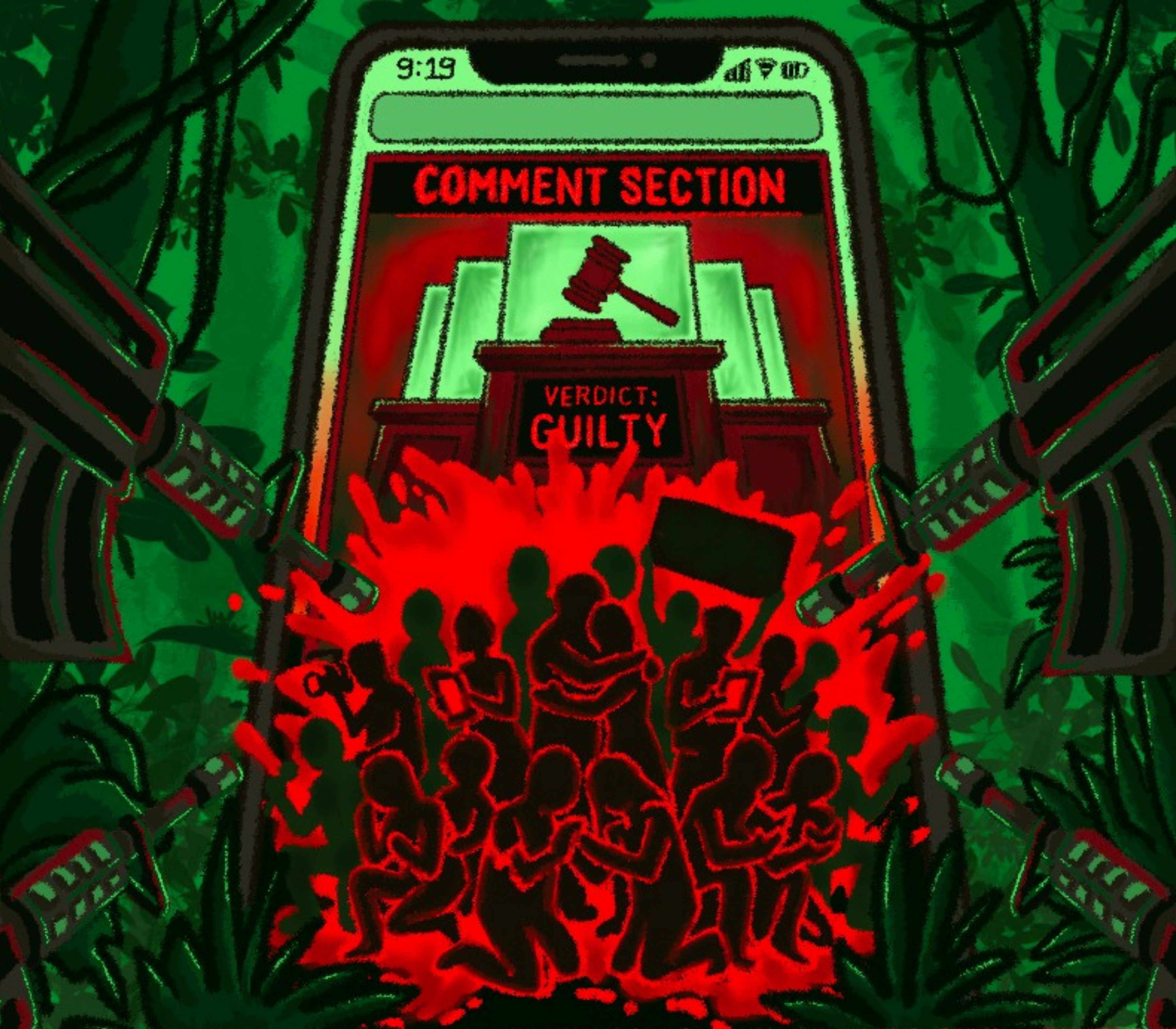
IN THE WAKE of the Toboso 19 massacre, public attention settled on competing narratives and ongoing investigations. Yet, woven through the noise was another story—one told through reactions, assumptions, and the ease with which empathy seemed to slip from the conversation. As opinions multiplied across screens, so did questions about human dignity, critical thought, and the words people choose when speaking of the dead.
An encounter transpired in Toboso, Negros Occidental, that took place on April 19. 19 people were killed by military forces, six of whom were civilian peasant advocates. This generated a sharply divided reaction across social media, where some users celebrated the killings and poked fun at the issue, all the while expressing support for similar military operations in the future. In contrast, others condemned the incident and demanded accountability, justice, and an independent investigation into the actions of the Armed Forces of the Philippines (AFP).
The meme of apathy
In the digital age, public opinion often forms at remarkable speed. A headline appears, a narrative takes hold, and judgment follows soon after with no hesitation or setbacks from online users.
Angela, who wished to remain anonymous, shared that there are more of these jokes that continue to insult the victims.
“Hindi nga lang ‘corned beef’ ‘yung nakita ko na comments. There were also comments na ‘nagagalaw ‘yan nung leader ng NPA”, she elaborated, showcasing the amount of negative impact it has on social media.
Other than insulting memes, Laya*, a Psychology student who requestsed to withhold her identity, believes that these are heavily influenced by their political beliefs, making them choose sides instantly.
“One dangerous effect of hardline loyalty is dehumanization, kasi ang napapansin ko kasi dahil sa political bias or doon sa political loyalty nagiging insensitive na yung mga tao… This can normalize insensitive behavior, of course, online mockery, or support for violence,” she expounded.
Angela has also agreed to this sentiment, pointing out that some have begun to be out of touch in reality, “Kasi to them, hindi nila naranasan, they just felt safe, alam mo ‘yun?” she utters.
The online response highlights a broader and sinister pattern taking place in digital spaces, where victims of tragedies are no longer respected but have become subjects of ridicule, jokes, or dehumanizing comments.
In spaces where opinions formed rapidly, Ani (not his real name), an Agriculture student at Central Mindanao University, stressed the importance of resisting the urge to immediately join the noise.
“Let us be sensitive enough to fully absorb the issue rather than taking sides or making harsh comments,” he expressed.
“Before we act or comment on something related to this issue, we should first fact-check. Check first the necessary reference or the information we have gathered from that,” reminded Beige Campbell, President of the College of Arts and Sciences Student Council (CAS-SC).
The weight of a name
Following the controversy surrounding the deaths of individuals during the encounter, public discourse quickly shifted from mourning to online ridicule. Family members of the victims, including relatives of Alyssa Alano, found themselves facing scrutiny and insensitive remarks on social media.
Among the most criticized reactions were the circulation of comments and posts comparing the victims’ remains to “corned beef,” further stealing their dignity even in death. Such actions have been viewed by many as a sign of the growing desensitization to human suffering in online spaces, leaving grieving families to endure not only loss but also public ridicule.
Angela believes that the families do not deserve this treatment, seeing that empathy on social media is disappearing. She says, “Sige, kahit wala kang respeto doon sa namatay, basta respetuhin mo man lang ‘yung pamilya nung namatayan… People were so quick to label, and we’re so quick to judge.”
Additionally, Ani states, “May mga pamilya din ‘yun eh. ‘Yung mga estudyante na nadamay, ‘yung mga researchers na nadamay, at mga mamamahayag na kinitilan ang buhay. May mga pamilya rin ‘yung nasasaktan at nagluluksa.”
This can be seen in a similar reaction to Laya, “Nalungkot ako and concerned, especially na kung paano ‘yung mga tao or ‘yung mga tao online dehumanize the victims.”
Moreover, Beige expressed disappointment over the way some users responded to the issue online. Seeing the comments revealed how easily the names of the victims became attached to ridicule, “It [has] disheartened me to see na ginagawa na lang joke. ‘Yung lalo na buhay ng tao ang nawala.”
Reading between the headlines
Investigations unfold gradually, evidence develops over time, and competing narratives demand scrutiny. As new findings entered public conversation, interviewees repeatedly returned to the importance of examining information carefully and allowing evidence to develop before settling on certainty.
Among the developments that challenged early narratives were the findings presented by forensic pathologist Dr. Raquel Fortun after examining several of the victims’ remains. Her observations debunked claims circulating online that the victims resembled “corned beef” because of the extent of their injuries.
Angela explains, “[O]nce nai-plant na kasi ni AFP or ng media ‘yung unang information, ‘yung pangalawang information, and that sticks on it, so even though meron ng itong findings [ni] Dr. Fortun, it’s not so easy to turn the narrative,” highlighting the difficulty of reshaping public perception once a narrative has taken root.
For Laya, these concerns highlight the importance of transparency and accountability throughout the investigative process. “The public still deserves a clear and truthful explanation sa kung ano talaga yung nangyayari,” she expressed.
Laya also shared her reflection on the implications of concerns regarding the handling of evidence. “[I]nvestigations should rely on evidence and due process, not only emotions and assumptions,” emphasizing the need for approaching these discussions carefully.
Ani believed that accountability remains inseparable from the search for truth. Questions surrounding the encounter, he noted, require careful examination “[N]angangailangan din ng credible and independent investigation so the truth can be established based on evidence rather than political narratives alone,” he affirms—not conclusions shaped by loyalty, speculation, or public pressure.
Similar sentiments emerged from Beige, who stressed the importance of allowing investigations to proceed thoroughly before conclusions are drawn.
“We should conduct proper investigation to have properly assessed kung ano ba talaga ang nangyari doon, ano ba ang naging epekto nito sa mga taong nandoon, or sino ba talaga ang tunay na makasalanan,” he said.
His remarks echoed a recurring sentiment: understanding often requires patience. This is a developing story, and as new information continues to surface, certainty can be difficult to claim while questions remain unanswered.
While acknowledging these uncertainties, Beige reflected on the roles citizens can play in these issues. “We may not have all the answers in the situation that we have, but we can contribute something–empathy, awareness, and our commitment to what is just,” he shared.
News cycles move quickly. Public attention shifts. New controversies eventually replace old ones. Yet the values revealed in moments of crisis often endure long after headlines fade. The conversations surrounding Toboso 19 serve as a reminder that every public discussion carries human consequences.
The reactions that followed also reflect a broader pattern of desensitization shaped by repeated exposure to violence in public discourse, where red-tagging, extrajudicial killings, and dehumanizing language have gradually made it easier for some to respond to tragedy with detachment.
(with Andrea Dominique Romero and Alexandrea Narbasa)