
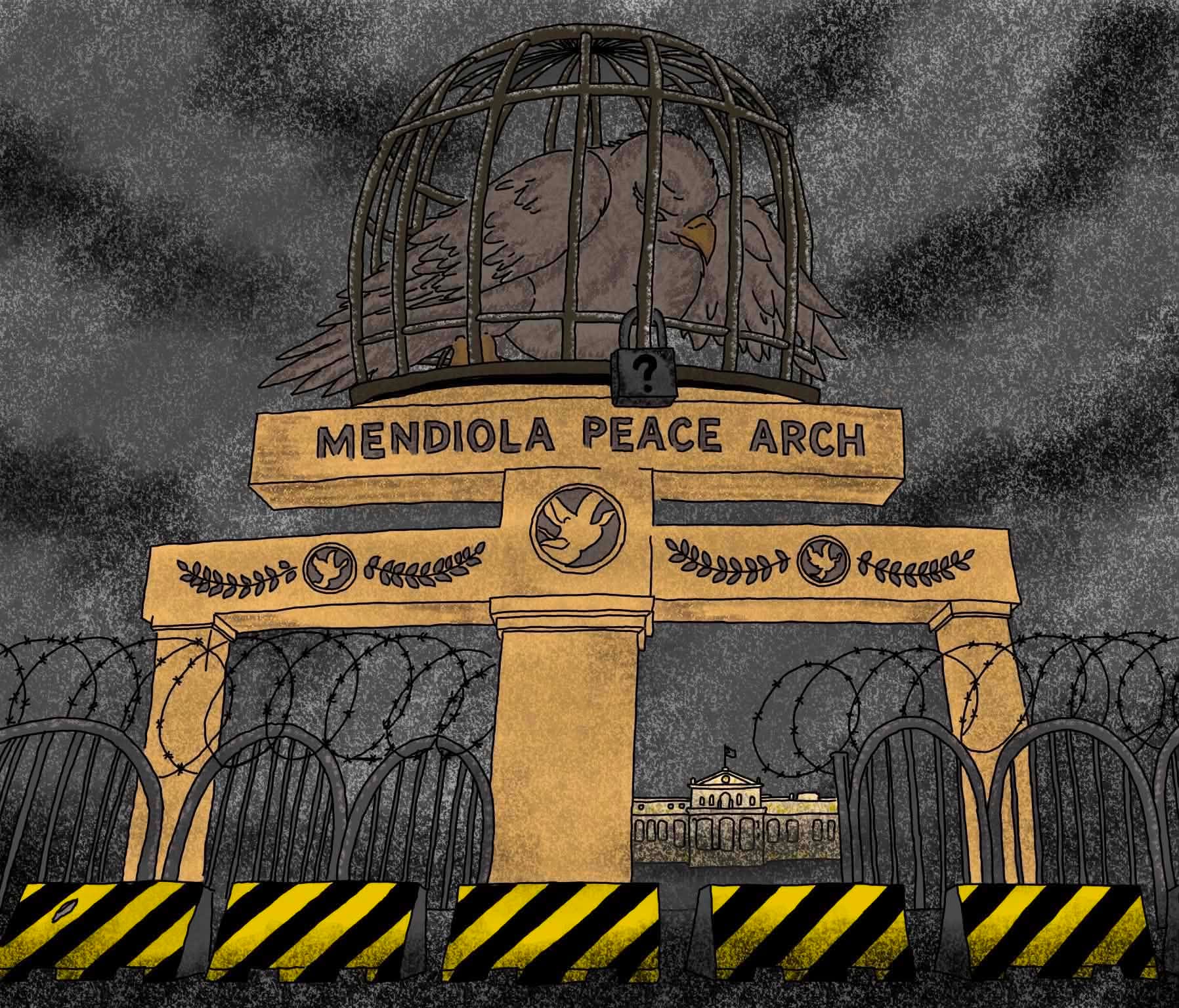
NOTHING BUT DISGRACE as the once-temporary barricades have crept in to embed themselves into permanence, putting a halt to the accustomed feeling of waiting for their departure, locking peace into mere memory beneath the Mendiola Peace Arch. Truth be told, every student within the Arch’s proximity can attest that peace is not what the place sends; peace has long been muted by the thunder of its unwelcoming reception.
The Peace Arch stands at the gates of Mendiola as a symbol of harmony between the government and Filipino people, yet the barricades that surround it tell a different story. Under a name that promises peace lies an enduring irony: a symbol of unity standing guard over a space where voices are too often kept at a distance.
It was on Labor Day last year when authorities reintroduced barbed-wire barricades in Mendiola—a sight reminiscent of the Martial Law era, yet one that has no place in a democratic society. While police have long blocked protesters from reaching the Peace Arch during demonstrations, the return of barbed wire marked a troubling escalation, transforming a space meant for public expression into one of intimidation.
Months later, on September 21, 2025, the aftermath of the Martial Law commemoration, widely remembered as the “Baha sa Luneta” protest, prompted authorities to further tighten security in the area. Today, barbed-wire barricades encircle the Peace Arch, forcing students and pedestrians alike to pass through narrow openings, leaving the monument to stand as a stark contradiction of the space it now overlooks.
A street intended to become a direct path for the common people to the government, a learning hub where democracy is personified through the free flow of ideas, and a historic site for activism, is now turned into an edifice of the government’s military power, trumping over what was originally a symbol for peace, furthering the notion that the government is an apex predator.
In a show of force, hundreds, if not thousands, of state forces have been deployed and stationed in the area numerous times—a stark display of the government baring its fangs and unsheathing its claws. Institutions and forces established to serve and protect the people are instead wielded as instruments of intimidation, sending a chilling message to those who dare to express their discontent with the government and its actions. So we ask, “To serve and protect whom?”
A government is supposed to listen to the people and heed the call of the nation. But how is it to fulfill such a duty when they themselves not only ignore but actively silence dissent?
The symbolic dove atop the arch is no longer a testament to peace between the government and its subjects but a reflection of the state in one of its darkest hours.
Like father, like son. In the same way that the dictator father of the current President chose to exhibit the power that the government, not so much of the people, possessed, besmirching the honor of the democratic marker, the incumbent president chose to fade into mere memory the Mendiola that does not scream of stomach-churning images of rusting metals topped with towering walls in the form of shipping containers.
Nearly four decades later, the dictator’s namesake and son has returned—not only to the highest office of the land, but seemingly to the same methods once employed by his father to curtail protest and dissent.
What was once a thoroughfare buzzling with students and filled with youthful optimism has now been transformed into a war zone of sorts. The street no longer echoes the hopes of the youth as it has been drowned out by the imposing presence of the state.
As we pass through the gates or even look from afar at its current reality day in and day out, may we ponder not only the inconvenience the barricades have caused but also what such a setup symbolizes to the people.
As Bedans who invariably move through the arch and as people who carry the Benedictine values, let us all remind ourselves of how such a monument is where democracy lives and thrives—how we should carry on searching for where peace is when it appears to be lost.