
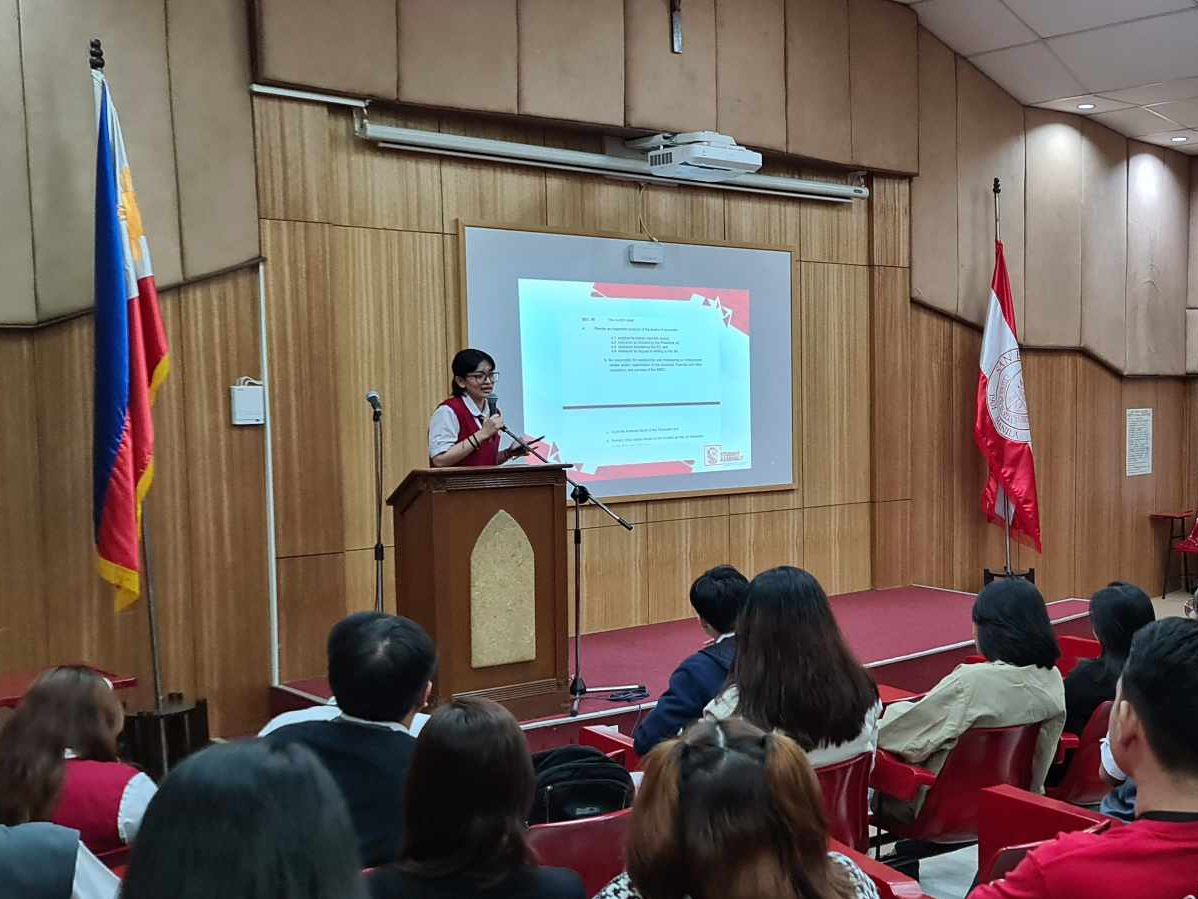
IN A SURPRISING turn of events, the Student Assembly, which was held at the Pamanang Bedista last December 1, headed by the Student Council (SC) President, Eunice Bermudez, was unsuccessful in revising the “issues and lapses” of the SC Constitution and Omnibus Election Code (OEC) of the College of Arts and Sciences (CAS) after failing to reach the required threshold in order to proceed.
The session was meant to “properly represent” the CAS student body through the convention of an Assembly, in which the SC and the San Beda Electoral Board (ELBO) sought to have more “transparent, democratic, and progressive” laws in the University.
All the CAS homeroom presidents and/or beadles from first to fourth year levels were invited to join the assembly.
Bermudez led the opening remarks and discussed the objectives of the event. “The Student Assembly provided a forum to discuss and decide on the lapses and vagueness present in the aforementioned documents—one of the most pressing issues concerning the College of Arts and Sciences (CAS) students,” she said.
The SC President also cited Article V, Section 1 (h) of the San Beda University (SBU) CAS SC Constitution as the basis of the activity, which enabled her to chair a Student Assembly, albeit without any voting power. Moreover, Article VIII, Section 03 of the Constitution stipulates that the Assembly serves as the “avenue for discussion of issues” affecting the whole CAS student body.
“The main objective is to produce transitory provisions that will be used for the upcoming General Elections in May 2024 in consideration of the time left should the majority of the Student Assembly vote in the affirmative,” Bermudez elaborated.
According to Bermudez, the Student Assembly will be changed, have separate officers, and will be called the “Student Congress,” which will become a sort of legislative branch of the CAS student body.
She also cited following issues in the SC Constitution: Article VI, which is regarding the need for restructuring of the executive committees to their current functions; Article VIII by naming the Student Assembly as Student Congress which will be a separate body from the SC for discussion of issues among CAS students; Section of Article XII regarding the assumption of official the schedule of filing under Article XIV Sec. 1; Article IV, Sec 5 (d) being suggested to have a student enrolled in at least 15 units pertinent to the prescribed curriculum of the student’s respective major, unless the program provides a lesser unit under a regular status, and; Article XIV Sec. 3 when it comes to the disqualification in campaigning during elections.
After Bermudez’s remarks, Ayrah Celline Asis, the ELBO Chairperson, discussed the issues pertaining to the CAS OEC. She commented on how the previous elections made them “acknowledge the problems that arise from the vagueness of the OEC.” Hence, they sought for revisions on the said statute “in order to create a more inclusive and democratic space for the Bedan community.”
For the ELBO’s part, their priority is the revision of election-related provisions that are not consistent with the SC Constitution. In line with this, they see it necessary to review the provisions that no longer serve the best interest of the Bedan community which includes abstention, the violation cases and the schedule of filing, the latter of which was asked if they will adjust the submission of requirements.
Thus, there are several issues and suggestions that were raised by ELBO regarding the OEC: Article II to include impeachment of any officials of the Electoral Board shall be through deliberation en banc; Art II, Sec. 1 to have a Vice Chairperson position by adding one or deduct one seat for the commissioners to make the number of seats an odd number; Art IV, Sec. 1 (b-c) by modifying the name titles for the respective positions to Vice President for Internal Affairs and Vice President for External Affairs; Art V, Sec. 1-2 wherein it does not assert the full essence of what a political party means and distinguish the rights and privileges of an accredited political party compared to an unaccredited political party; Art VII, Sec 6 that is too limiting for the campaign team, and; Art XI, Sec 6 (a) which is vague as to when it must be applied.
Asis said when the participants asked her how long this provision would take, she said “since May ang next election,” it would surely be before then.
Overall, both the SC President and ELBO Chairperson concurred that they would have a transitory provision that will be valid in the next academic year.
However, after more than 30 minutes of waiting for the result of the ballot, out of 73 registered voters, only 46 voted and joined in the election. Bermudez said that “there are 92 officers in the CAS and 50% plus one which is 47 should vote.” With only 46 voters who joined in the election, the SC President announced that the election was a “failure.”
Bermudez believed that this event could serve as a “manifestation for more preparation and collaboration” among all members of the student assembly with ELBO for the next convention but with more sense of leadership and volunteerism.
For Bermudez, she concluded that it is high time for student-leaders to “step forward” and coordinate in discussing the lapses of the University laws so that the students’ concerns can be addressed in a transparent process and for a long-term impact.
“Since we will be having a re-convention, I urge all the homeroom presidents/beadles to actively participate in this endeavor once again and have an open mind in strategizing and collaborating,” she stressed.