
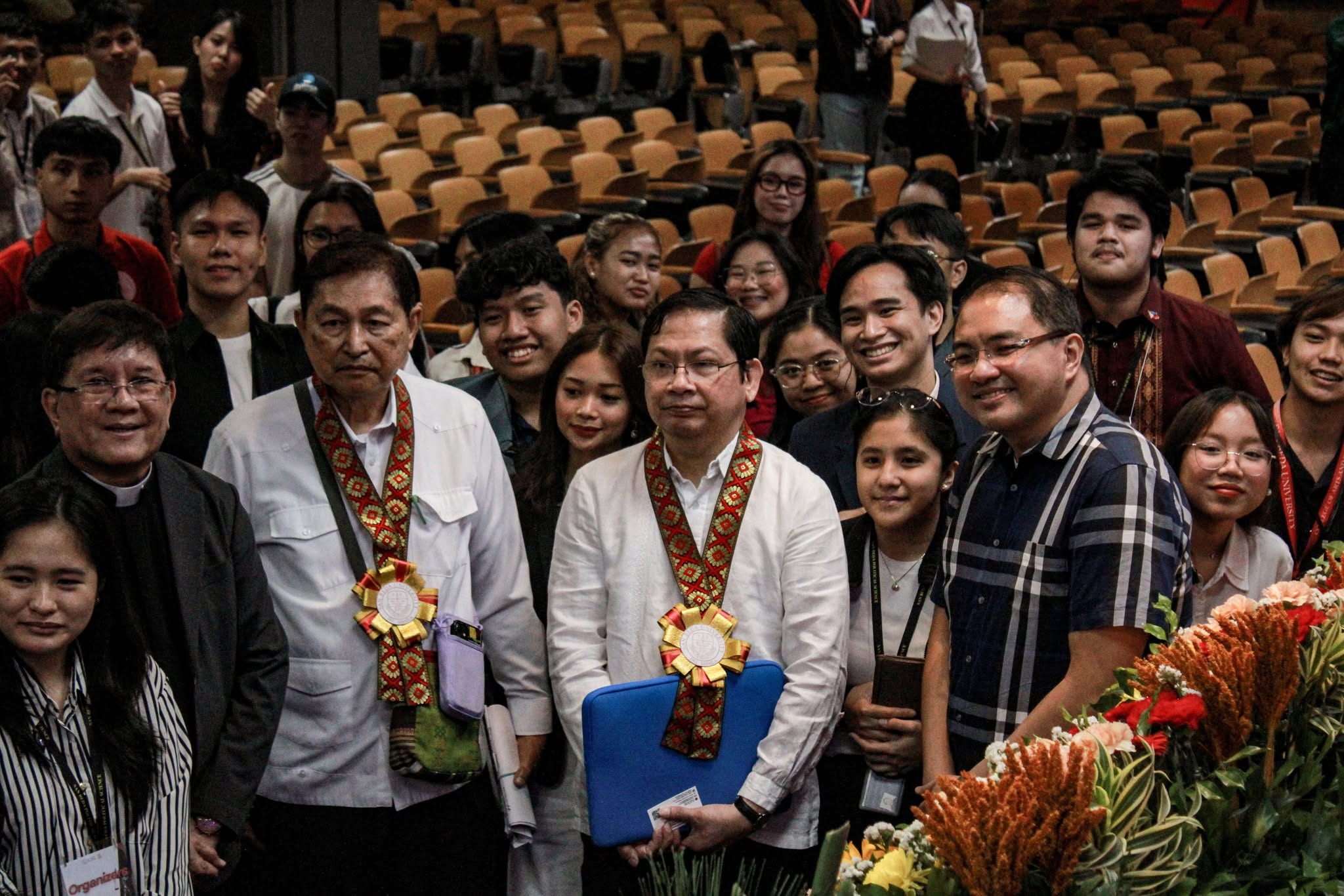
PROMOTING GOOD JUDGEMENT, the Graduate School of Law (GSL) instituted a colloquium in synergy with The Repvblic (TR), deliberating on the International Criminal Court (ICC), International Humanitarian Law (IHL), and International Criminal Law (ICL) last March 27 at the Jonathan Sy Auditorium.
As the strife continues to divide the nation due to the arrest of the Former President Rodrigo Roa Duterte, the GSL delivered an overall forum delineating the structure and jurisdiction of the ICC, IHL, and Crime Against Humanity in the jurisprudence of ICL, which was led by Former Associate Justice Adolfo S. Azcuna, Prof. Ricardo A. Sunga III, and Fr. Ranhillio Callangan Aquino.
Hon. Justice Adolfo S. Azcuna introduced the ICC’s history and its composition of 135 state members, located in Hague, Netherlands.
He elaborated that the court ensures no impunity or crime of interest occurs and addresses the grave concern to the international community, including the crimes of genocide, war crimes, crimes against humanity, and the crime of aggression.
“These four crimes are the most serious offenses in international law, and these are put under the jurisdiction of the then-newly created International Criminal Court,” Justice Azcuna noted.
Justice Azcuna then emphasized that, despite circumstances, whether the perpetrator was unaware or aware of the crime, as long as they did not execute retribution, they are liable as superiors with superior responsibility under the Statute of Rome. “The defendants in ICC are usually charged as perpetrators, or co-perpetrators, or what they call, superiors–superiors are those who ordered the crimes or who failed to stop it,” said the Justice.
Wrapping up the first segment, Justice Azcuna debunked the false prosecution of the national authorities on a criminal case, asserting that it was a shielding operation. “Can the Philippines say that in the matter of FPRRD, the Philippines has genuinely persecuted this person? We did not.”
Subsequently, Prof. Ricardo A. Sunga III disclosed that the International Humanitarian Law is a part of human rights in terms of war, while the International Human Rights Law covers both violations of rights in times of war and peace.
In his presentation, Prof. Sunga underscored the message of the International Humanitarian Law: “Not everything is fair game during war; there should not be any excesses during an armed conflict.”
Eventually, Fr. Ranhillio Callangan Aquino concluded the forum by mentioning where the International Criminal Tribunal for the Former Yugoslavia ruled that discrimination is not an element of the offense of crimes against humanity.
“Whether we are a member of the Rome Statute or not, the offenses defined and penalized by that statute are defined and penalized by domestic laws alone… and the jurisdiction of International Tribunal may be recognized, and they may be allowed to exercise jurisdiction by virtue of a domestic law,” Fr. Aquino clarified.
Addressing claims made by supporters of the detained Rodrigo Duterte, Fr. Aquino argued that “there is no interference there because we allowed them, much besides as pointed out in the forum–our own domestic law, Republic Act 9851 allows us to recognize and allows the court to exercise jurisdiction over crimes committed within our jurisdiction, or by our nationals.”
As heated debates persist, Justice Azcuna highlights the forum’s contribution to the enlightenment of the people: “The importance is the, again, achieving the purpose of the ICC, to make sure that those who commit these grave offenses do not go unpunished. And so… the only way to do that is to cooperate with the ICC by helping it to arrest the offenders or suspected offenders to be tried in the ICC.
To a greater extent, Prof. Sunga III comments that there are various perspectives presented on the current state of the Philippines, such as the signature campaign for the return of the Former President.
“So, it’s good to have a sober discussion on the issues and… not to be moved so much by motion but really going down into what the law says–what can be done and what cannot be done,” Prof. Sunga III remarked.
Liv Algren Roxas, a sophomore from the Department of Political Science, is “firm” that the colloquium is pivotal for the knowledge of everyone, most especially during the controversial arrest of Duterte.
“The discussion of ICC sheds light on a state that is very close-minded to intervention of outside or foreign power and enlightens how an international organization does the job of our local justice system in handling the case of an influential and high-status individual,” he stated.
While the issue remains divisive, Fr. Aquino expressed “optimism,” stating that “eventually, people will see the wisdom of having a neutral international tribunal handle the case.”