
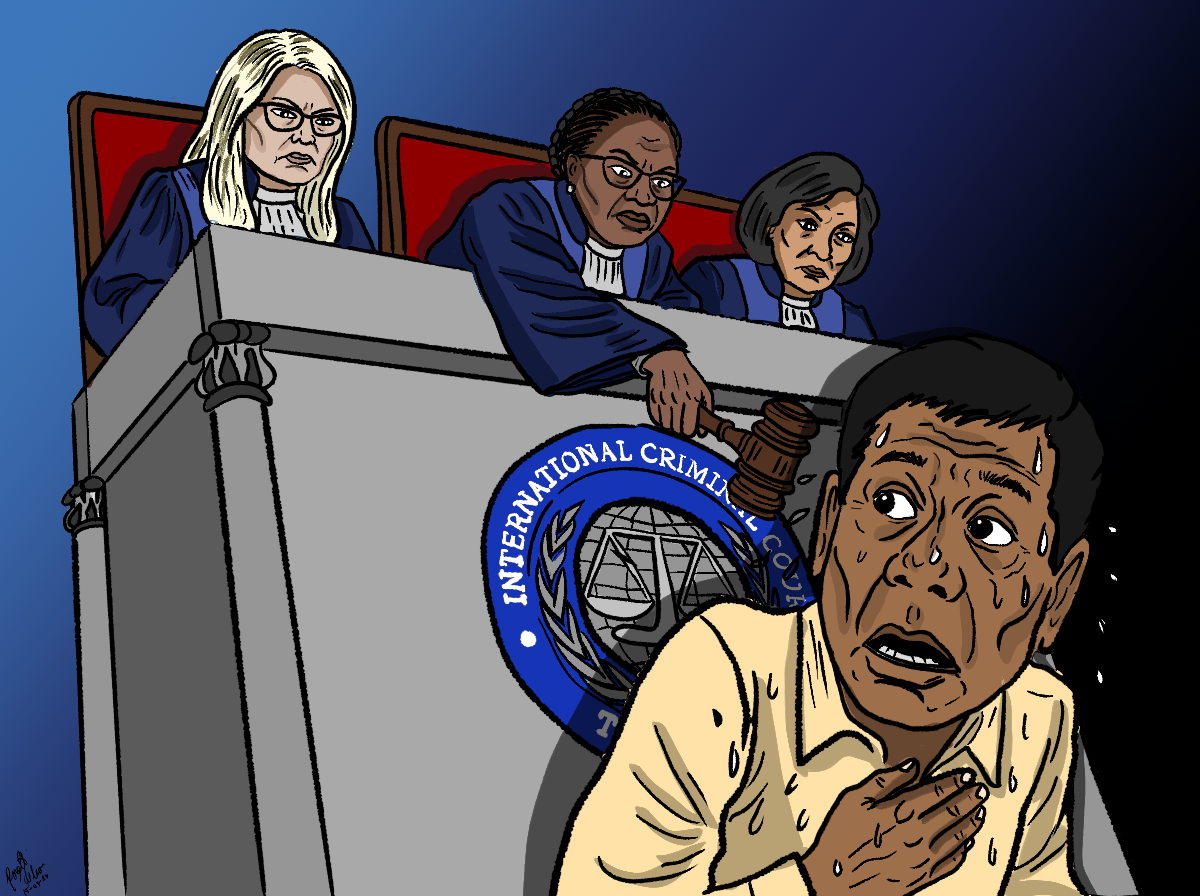
ONCE MARKED BY brazen misogyny, former president Rodrigo Duterte now stands before the International Criminal Court (ICC) as his case unfolds under the scrutiny of women judges and journalists, in a moment that underscores the reckoning over a legacy that has deeply affected countless mothers, wives, sisters, and daughter.
For years, Duterte’s language reduced women to punchlines and objects of ridicule, normalizing a culture where misogyny could be wielded as humor and power. But beyond the headlines and viral remarks lay a more insidious reality, one where violence, emboldened by impunity, carved its way into Filipino homes, leaving women to bear its deepest wounds.
In an interview with ABS-CBN news, Llore Pasco, a mother who lost two sons during the Extrajudicial Killings (EJK) facilitated by the previous administration, said, “swerte nila na sila ay may due process, hindi tulad sa aming mga mahal sa buhay na ganun na lang po, pinaslang na lang na wala man lang imbestigasyon,” as she reflected on Duterte’s ICC arrest.
Meanwhile, Jane Lee, wife of EJK victim Michael Lee echoed the same sentiment in a press conference last March 11, 2025 following Duterte’s ICC arrest.
“Buti pa siya, inaresto siya, samantalang ‘yung asawa ko at iba pang biktima binaril na lang, pinatay na lang nang ganon-ganon lang,” she said.
Jecel Pepito, daughter of Marlon Pepito and niece of Maximo Pepito, also recalled with an interview with Inquirer how her father was wrongly accused due to a shared name with another suspect, while her uncle tried to intervene and ask the police what his brother had done. Speaking in Bisaya, the police did not understand him and shot both her uncle and her father.
The war on drugs did not only claim lives; it reshaped the lives of those left behind, with a dominant number of them being women. Wives became widows overnight. Mothers mourned sons labeled as criminals without trial. Daughters grew up in the shadow of violence that offered no space for closure.
Their narratives cleanse the deceptive illustrations and faulty discourse that once framed the campaign as necessary or justified. Their voices reveal the human cost of a policy that thrived on fear and silence. And for many of these women, speaking out is itself an act of resistance, a refusal to let their loved ones be reduced to statistics or dismissed as collateral damage.
Yet for the women who continue to grieve, justice remains incomplete. The due process now afforded to Duterte stands in stark contrast to the deaths that left Pasco, Lee, and Pepito navigating lives shaped by loss, silence, and survival.
Now, as Duterte faces an international tribunal, a long-overdue reckoning unfolds.
In March of 2018, Duterte drew backlash after referring to ICC prosecutor Fatou Bensouda “that black woman,” and describing United Nations (UN) human rights rapporteur Agnes Callamard as “skinny” and “malnourished,” remarks widely condemned as sexist and demeaning.
Over the years, he also made repeated rape jokes that further entrenched a culture of impunity. On May 27, 2017, he told soldiers stationed in Mindanao that they could rape “three women” and he would take responsibility, even joking about assaulting a Miss Universe, explicitly saying “you can mess with, maybe a Miss Universe. Maybe I will even congratulate you for having the balls to rape somebody when you know you are going to die,” sparking outrage from human rights and women’s groups.
In a striking turn of irony, this same pattern of misogyny now frames his reckoning as his case unfolds before institutions where women assert authority, credibility, and judgment.
This moment highlights more than personal irony; it exposes the systems that allowed misogyny and state-induced violence to thrive unchecked and forces a confrontation with structures that silenced victims while shielding those in power.
Still, it is the voices of women, long dismissed yet unbroken, that define this reckoning. A man who once diminished women now stands to be judged, recorded, and held accountable by them, proving that authority, truth, and justice can ultimately belong to those he tried to silence.