
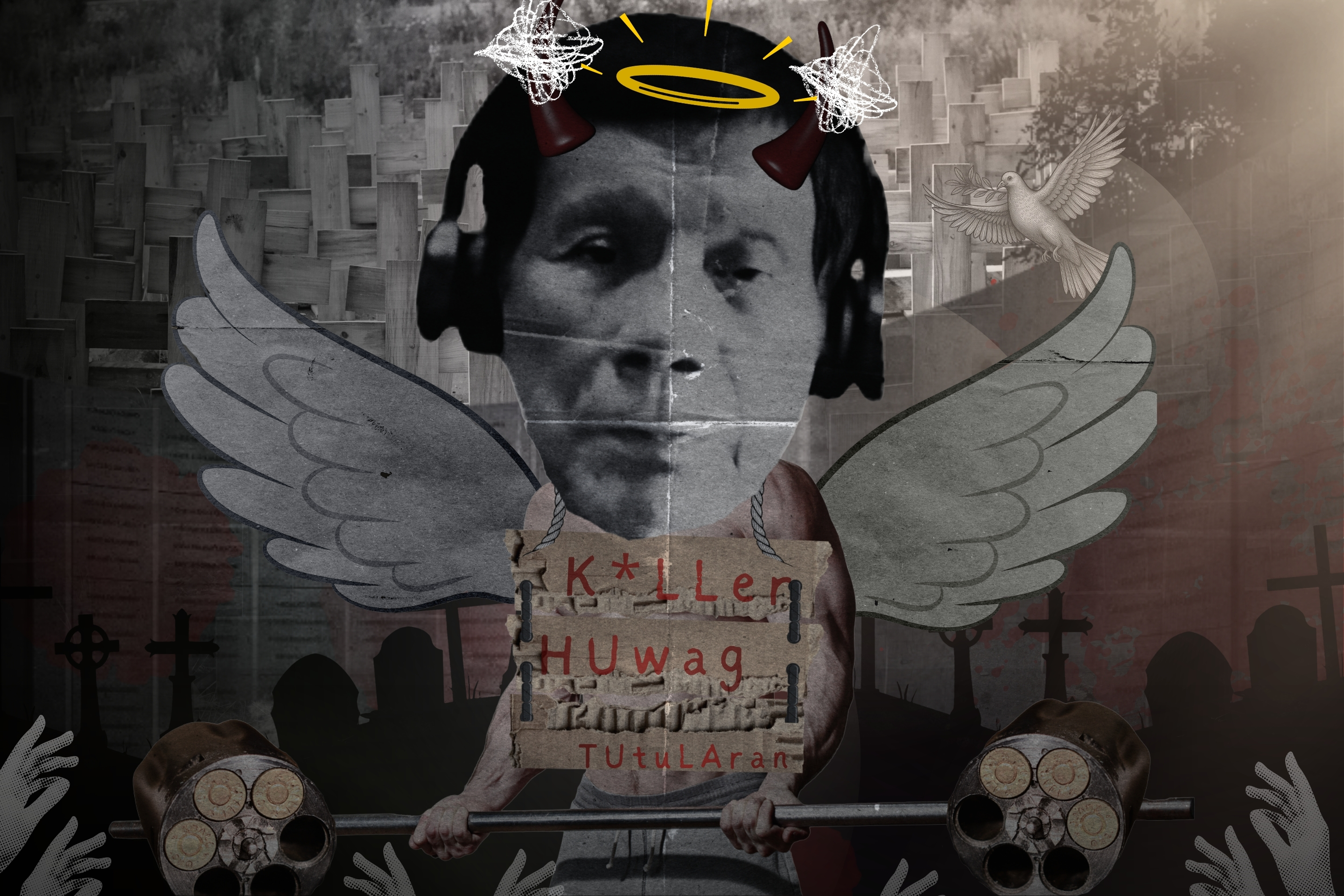
I PRAY FROM the Earth to the Heavens, pleading with all the angels and saints to let former President Rodrigo Duterte live a long life. Long enough to witness an international tribunal deliver justice for the souls lost to his bloody war on drugs, the families he left shattered, and the lives forever altered under his rule.
After taking office on June 30, 2016, Duterte waged the campaign that would define his presidency: The bloody War on Drugs, a nationwide crusade that claimed the lives of thousands, with many of them from impoverished communities. In wielding the power of the state, he carried himself as though he were a deity, a dictator deciding who would live and who would die.
Most, if not all, victims of extrajudicial killings (EJK) died instantly, felled by bullets fired by men in uniform who vowed to serve and protect the Filipino people. Their deaths may have been immediate, but for the families they left behind, the fight for justice continues—a fight that, for many, requires Duterte to remain alive long enough to face accountability for the lives lost under his rule.
The suppressed pleas
In an interview with The Bedan, the sibling of a fallen victim of EJK shared their truth that was sealed for the masses to know. September 27, 2018, a tragedy occurred on an otherwise ordinary day, unaware that the meal shared with siblings and family would be the last one, as four alleged police officers wearing bonnets shot the victim and left behind a horrifying scene.
The first shot did not take the victim’s life instantaneously. Eye out, convulsing from the initial shot, the vigilantes, discontented, ensured that such a bullet would take his life right then and there, pulling the trigger for another shot to the head, dehumanizing the victim by stripping him of his dignity and treating him like an animal as they tossed his lifeless body around.
The victim’s siblings were left in a state of helplessness, unable to do anything, restrained by the barriers created by the system, despite the truth they allegedly carried. “Lalapit sana ‘yung anak ko, hinarang ko sabi ko ‘wag na makialam diyan, baka madamay ka tapos ‘yung kapitbahay namin, kahit nakita, walang magtetestigo kahit na may CCTV,” his sibling somberly expressed as she recalls the tragedy.
For another victim’s family member, who wishes to remain anonymous; justice carries a different weight: “Matuluyan talaga si Duterte o kaya mamatay nalang din siya.” She acknowledged, however, that Duterte may simply die from illness or natural causes, an unjust possibility that would leave her brother’s death without the justice she believes he deserves.
The possibility of Duterte dying before facing the consequences of his actions carries a painful sense of unfinished justice. For Elizabeth Campo, wife of EJK victim Rolando Campo, an interview with The Bedan revealed her frustration and despair, as she expressed her wish for the injustice allegedly inflicted on her family by the former president to be met with accountability. “Bago sana siya mamatay, pagsisihan niya muna ang ginawa niya sa pamilya namin,” she said.
Justice beyond one man
Their plea is only one among the many voices that continue to demand that the dead not be forgotten. 10 years after the bloody War on Drugs, the Philippine Human Rights Information Center (PhilRights) launched “Amin ang Hustisiya,” its final monitoring and documentation report on the campaign. The report presents quantitative data on victims documented from 2017 to 2026, highlighting those most vulnerable to direct violence and the families they left behind, while also summarizing recent developments in Duterte’s case before the International Criminal Court (ICC) and the responses of victims’ families.
The presentation of the report was followed by a panel segment featuring Atty. Nicolene Arcaina, Executive Director of the Ateneo Human Rights Center (AHRC), which discussed the implications of Duterte’s possible death on the pursuit of justice for the victims and their families.
The discussion highlighted how Duterte’s death could extinguish his criminal liability, meaning he could no longer be convicted, while the case could still proceed against his alleged co-perpetrators, including his left-hand man Senator Ronald “Bato” Dela Rosa, who is already turning tail before the tribunal, remaining at large in the face of the issuance of an arrest warrant.
Atty. Arcaina clarified that Duterte’s death would not mean “all hope is lost,” as proceedings could still take a different direction toward those who remain. For victims’ families, however, the possibility of his death before judgment carries a different weight, as they continue to hope that he lives long enough to face accountability for the lives lost under his rule—he lives long enough for his death, coupled with the Duterte propaganda of innocence, not to clean his bloodied hands in the absence of a final and executory judgment of his vigilante persona.
Yet beyond the legal proceedings lies the very principle at the heart of the victims’ demands. Ironically, Duterte once said, “your concern is human rights, mine is human lives,” a contradiction in itself, as the protection of human life is fundamental to the very concept of human rights. In separating the two, his words overlook the very principle that human rights seek to uphold, that every life deserves dignity, protection, and accountability, a principle that for many families of EJK victims means carrying the wait for justice beyond one lifetime until accountability is finally served.
And perhaps, in the end, the distinction between human rights and human lives disappears in the voices of those left behind, whose years of waiting have turned the principle of dignity, protection, and accountability into a demand that can no longer be silenced.
And so, the outcry returns to where it began: With a prayer for time. Oh, dear Lord, hear the voice of the victims’ families echoing through the halls of an international tribunal.
May their pleas endure beyond the passage of time, and may the lives lost during the bloody campaign never be reduced to forgotten names. May Duterte live a long life, long enough to hear those voices, witness the truth rise above the silence left by the dead, and see accountability finally reach those who must answer for the lives lost, so that the victims and their families may finally be freed from their agony, not through vengeance, but through the justice owed to those whose lives were taken away.
Long live, Mr. President! Live the time you have stolen from every victim whose life you have cut short. May the man whose hands took years from others be made to live what he has stolen.