
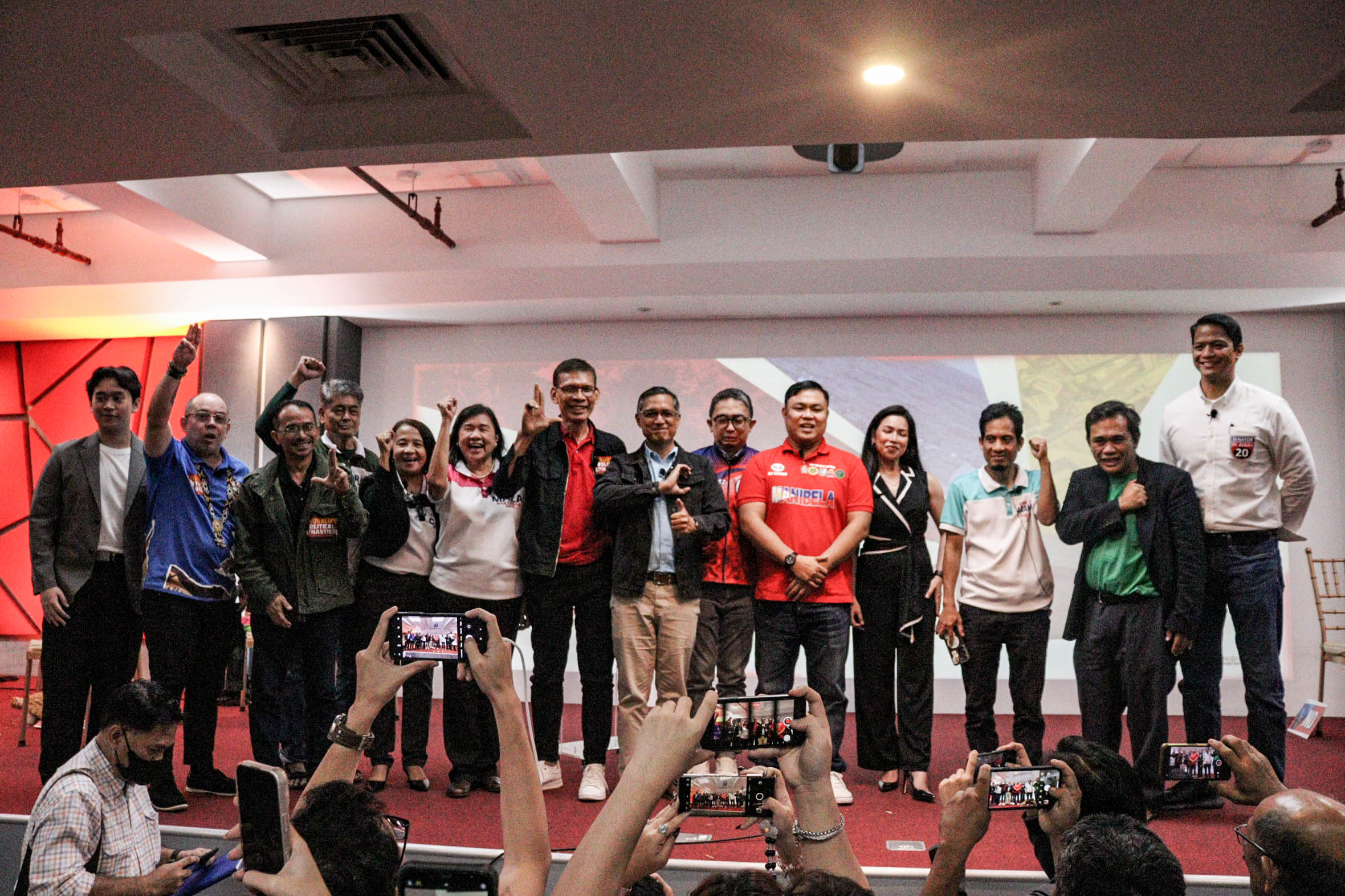
IN CLOSE COLLABORATION with ABS-CBN, The Repvblic (TR) hosted the “TApat na SerbisYO: A Senatorial Debate 2025,” featuring 12 senatorial aspirants for the 2025 Philippine midterm elections at the Jonathan Sy Auditorium last February 12.
Participating in the Senatorial Debate were former Bayan Muna Rep., Teddy Casiño; France Castro from ACT Teachers Partylist; environmentalist David D’Angelo; independent candidate Atty. Angelo de Alban; labor leaders Leody de Guzman and Atty. Luke Espiritu; Valenzuela 2nd District Representative, Eric Martinez; former Gabriela Women’s Partylist Representative, Liza Maza; Chairman of Kilusang Magbubukid ng Pilipinas (KMP), Danilo Ramos; Manibela Chairman, Mar Valbuena; fisherman Ronnel Arambulo; and environmentalist Roy Cabonegro.
Before the series of rounds began, the candidates were asked, “Sa nakasanayang politika, ano ang isang bagong bagay na iyong maipapamahagi?”
Arambulo first took the stage to discuss the prevalence of political dynasties and traditional politics, citing its effects on the welfare of fisherfolk such as himself. “Sa deka-dekadang panahon ay nakita natin na hindi ito naglingkod sa mga mamamayang Pilipino, lalo sa amin, sa mga mangingisda.”
Meanwhile, Cabunegro underscored the urgency of addressing environmental issues, asserting that the next administration must take decisive action on climate concerns. Furthermore, he stressed that environmental problems will not wait for good governance, stating, “Ang susunod na politika sa bansa ay politika ng kalikasan.”
D’Angelo, who echoed the same environment-driven sentiments, stressed the need to address the ongoing climate crisis in the country while placing another emphasis on animal welfare as a swipe to sitting officials. “…dala ko rin ang welfare ng mga hayop, sapagkat ang hayop dapat alagaan, pero ang hayop na nasa gobyerno dapat na nating tanggalin, ngayon na.”
Adding to the call for systemic change, both De Guzman and Espiritu denounced the existence of political dynasties, focusing instead on a politics that caters to the marginalized communities instead of the elite. “Politika ng masa, politika ng mga mamamayang pinagsasamantalahan at hindi politika ng mga elitista, ng mga dynastiya, trapo, at mga magnanakaw sa gobyerno. yun ang bagong politika natin,” said De Guzman.
“Ang mga bago na madadala natin sa senado ay ‘yung oomph! ‘Yung oomph!,” Espiritu remarked.
For his part, De Alban, offering his expertise as a lawyer and professor, called for judicial reforms, pushing for increased funding for the courts to expedite cases, expand judicial capacity, and ensure the safety of witnesses and to alleviate corruption.
Castro, who advocates for a “politics of true change,” believes that the Makabayan coalition’s purpose is to serve the people in the pursuit of a national democracy. Moreover, she emphasized how their unity is based on genuine reforms rather than personal interests.
“’Di kami matutulad sa UniTeam na isang taon pa lamang, punit na,” she said, drawing a sharp contrast between their coalition and traditional political alliances.
Meanwhile, Valbuena, pushing for the welfare of the of Public Utility Vehicle (PUV) drivers amidst the jeepney modernization program, challenged the prevailing corruption of the current administration, saying “Merong pang lumalaban habang nandidito kami, gumitna kayo sa kalsada, sasagasaan namin kayong mga korap sa gobyerno!”
Martinez, on the other hand, highlighted his extensive legislative experience, positioning himself as a qualified candidate based on his track record. “Hindi man ako sikat, pero ang resume ko, karapat-dapat para sa senado ng Pilipinas.”
For Casino, the country needs senators who are not affiliated with political families, expressing his disconnect from these dynasties. “Kailangan natin ng mga senador na hindi ahente ng mga bilyonaryo, ng mga haciendero, ng mga foreign interest. Kailangan natin ang senador na hindi maka Duterte at Marcos, ngunit makabayan at makamasa.”
Maza called for a shift in the country’s foreign policy, advocating for independence and non-alignment in international affairs. “…there is such a thing as an independent foreign policy. Panahon na para tumindig tayo sa international community na kung saan tayo ay equal sa lahat ng bansa kahit maliit tayo.”
Finally, Danilo Ramos framed the new politics as one rooted in the ordinary people, particularly farmers, who should have a place in the Senate, asserting that “Ang bago ay taumbayan sa senado. Ordinaryong tao, magsasaka, itanim sa senado, taumbayan ang panalo.”
Round 1
In the first round of the selected topic portion of the event, Arambulo, De Guzman, De Alban, De Castro, D’Angelo, and Casino were asked, “Ano ang inyong pananaw ukol sa territorial integrity ng ating bansa pagdating sa West Philippine Sea (WPS).”
Arambulo, De Guzman, and De Alban stressed to fight for the claim in the WPS through “diplomatic” and “peaceful means.” De Alban also yearned for an “independent foreign policy,” sharing the same sentiments with De Castro who also believes removing Enhanced Defense Cooperation Agreement (EDCA) sites will help resolve the problems in WPS.
D’Angelo, on the other hand, pointed out that it is the Filipino’s “Constitutional Rights” to claim the sea, and to establish a treaty to preserve its natural resources.
Cansino, agreeing with each candidate’s stance, leaned upon a question “how do we build a credible defense?” to which D’Angelo responded, “Magagawa natin ‘yan kung pauunlarin natin ang sarili nating industriya.”
Later on, Cabunegro and Arambulo were asked, “Ano sa tingin mo ang karapat dapat na solusyon kaugnay sa proteksyon ng ating maritime waters habang isinaalang alang ang relasyon ng Pilipinas sa nasabing mga bansa?”
Cabunegro supposed that maritime waters are a “shared resource.” “Ang kapitbahay sa ASEAN ay dapat magkaisa.” Arambulo added that it is clear to strengthen national security without depending on China and the United States of America (USA) that only seeks to loot from the Philippine natural resources.
(by Rcee Tenefrancia)
Round 2
During the second round of the Selected Topic portion, Cabonegro, Espiritu, Valbuena, Martinez, Maza, and Ramos, were asked, “Sang ayon ba kayo sa pagpapatulad ng Social Amelioration Program? Oo o hindi at bakit?”
The Social Amelioration Program, as presented by the Department of Social Welfare and Development (DSWD), aims to provide financial assistance to less-fortunate Filipino families.
The aforementioned candidates shared the same sentiments in favor of the program. However, they mentioned that it must have limits and that it should not be used as a political patronage, being set as an alleyway for politicians to “vote-buy” instead of being deemed as a genuine assistance. Moreover, Maza says that it “should be distributed through agencies” and not merely from one sector of the government.
(by Manssel Jianne Latonero)
Round 3
The third round of the election debate continued without conflicting stances among the candidates. Opening the segment, a question on the minimum qualifications required by officials holding positions in government was asked given the current proliferation of corruption and political dynasties in Philippine politics.
Kicking off the question-and-answer portion, Arambulo, expressed the importance of sincerity to serve the people. “Unang una sa lahat… ang pinakamahalaga sa lahat, yung sinceridad, na tayo ay, itataguyod natin yung interes ng ating mga kababayan,” he said.
Concurring with Arambulo, de Guzman, expressed a need for mass leaders in government to genuinely address issues faced on ground, saying, “Hindi political dynasty… hindi trapo…hindi politikong bilyonaryo na ginagamit lang ang pera para manalo. Kinakailangan, galing sa hanay ng mga lider ng masa.”
Holding a similar stance was Castro, to which she added that for her, the current requirements prescribed in the constitution were fitting.
D’Angelo concurred with the constitutional requirements but centered more on the lack of their implementations, stating, “we just need to… retain the existing qualification, but implement the law.” Similarly, Casiño stated, “Wala po akong nakikitang problema sa kasalukuyang minimum requirements” but mentioned two additional provisions that he would like to propose. First, a prohibition against political dynasties, mentioning the present Sangguniang Kabataan (SK) law that possesses a stipulation against political dynasties that is absent in other positions in office.
Second, Casiño proposed a waiver on bank secrecy, saying, “Dapat lahat ng tatakbo, ibubukas nila, o papayagan nila na buksan ‘yung kanilang mga bank accounts,” to allow swift investigations on instances of unrevealed stolen wealth, as well as to better safeguard the election process.
With regard to divulging a candidate’s statement of assets, liabilities, and net worth (SALN), Atty. de Alban forwarded the need for open SALN to prevent instances of amassed ill-gotten wealth that could be spent on election campaigns. He also added the need for open drug testing to be taken by candidates.
(by Nathaniel Soriano)
Round 4
For the fourth cycle, Cabonegro, Espiritu, Valbuena, Martinez, Maza, and Ramos were the selected candidates to discuss the controversy of the economic laws concerning neoliberalism and the privatization, deregulation, and free trade it upholds.
Cabonegro associated his answer with environmental issues. “Ang problema sa power towards renewable energy, mahal–privatized kasi. Kaya ‘yong base load capacity natin sa renewable walang gustong mag-invest kasi nag-hands off ang gobyerno.” He further claimed that the Philippines is being left behind in renewable energy. Due to lack of time, Cabonegro expressed his dismay in being unable to tackle the issue with food.
Meanwhile, Atty. Espiritu said, “Ang ginagawa nila, itong mga bilyonaryong ito, kumikita lamang sa pagpa-privatize ng airport, ng ating mga daanan, ng ating mga tollgate, ng ating mga tubig.”
Valbuena emphasized the need for cybersecurity instead of targeting privatization. He also raised concerns about jeepney modernization and the oil deregulation law, stating “…dapat maibasura itong oil deregulation law na ‘to… dahil kapag tumaas ang produktong petrolyo, domino effect ito hanggang sa pagkakaroon ng mataas na implasyon.”
Martinez took a different stance, weighing in the supposed benefits of liberalization and privatization.
“Kung hindi natin kaya ba’t natin ipipilit? Pero kung kaya naman natin, ituloy natin ang pagpapalago nito, and of course, government should always exercise oversight functions para hindi umabuso kung sinuman ang mga kumpanya na nagpa-privatize ng mga government institution na ito,” he asserted.
Maza, disagreeing with the previous statement, firmly remarked, “Hindi nito pinaunlad ang ating ekonomiya, hindi nito pinaunlad ang ating bayan,” believing that multinational corporations and other capitalists are the country’s accomplices in implementing the neoliberal policies.
For Ramos, “Malaking epekto sa mga magsasaka at pati bawang 93% ang asiin, inaangkat sa China at Australia–hindi ang tugon ay import liberalization. Palakasin ang lokal na produksyon ng pagkain, hindi importasyon para sa atin.”
Valbuena and Casiño also confronted the matter of added taxes on pollutants, single-use plastics, and carbon emitters.
For Valbuena, tax should be added on the pollutants. “Doon sa mga gumagamit lang naman nito, kung hindi ka bibili, hindi naman ikaw ang mag-aambag doon sa taxes nito.”
In contrast, Casiño responded that this is a false neoliberal solution. “…sa usapin ng plastics kasi kung talagang masama ang plastic, eh ‘di pagbawal mo. Pero sasabihin nila, hindi lalagyan lang natin ng tax. Ano’ng epekto niyan? Hindi hihinto ‘yung pag-produce ng mga nakakasirang plastic sa ating environment.”
Casiño jokingly remarked that the plastics that should be banned are those that are two-faced, which Valbuena suggested removing them instead.
Finally, D’Angelo strongly advocated for a ban on single-use plastics. Meanwhile, Roy Cabonegro suggested using Extended Producer Responsibility (EPR) as a transitional measure, shifting the burden to producers. However, Cabonegro ultimately agreed with D’Angelo that pollutants must be banned.
(by Thirdy Pabilico with Maegan Belicena)
Round 5
The fifth cycle of the debate continued with the question of what the three sectors of interest the senatorial hopefuls will prioritize in the national budget and why. Arambulo, De Guzman, De Alban, Castro, D’Angelo, and Casiño were the senatorial hopefuls called to address the question.
Arambulo opened the discussion addressing the agricultural sector with food security as the focus. Second, he highlighted the health sector and the removal of funds this sector faced in the recent budget hearings. Lastly, he mentioned the education sector, and the budget cuts and lack of facilities this sector currently faces.
Leody de Guzma shared the same sentiments, mainly highlighting education and the need to allot six percent of the country’s Gross Domestic Product (GDP) into meeting educational needs. For the agricultural sector, he proposed tripling the allocated budget to meet not just food security, but food sovereignty for the nation. His last sector of concern is the industrial sector, highlighting the need for a self-sufficient industrial sector that is less reliant on foreign trade and products.
Following this, Atty. de Alban spoke on the need for a higher funded judiciary system as a solution for corruption in our country and efficient legal processes. He followed by citing education, specifically the higher education development fund to address training in the public and private education systems and special education. His last sector of concern is the health sector, citing the need for better health infrastructure funding after the experiences of the pandemic.
Meanwhile, Castro’s main sector of concern is education, citing the use of six percent of the country’s GDP to be allocated for education and hiring 30,000 new teachers and 24,000 principals in public schools. Next is health, tackling concerns of out-of-pocket payments for patients in public hospitals. She concluded by addressing the need for food security in the agricultural sector and the elimination of confidential funds in the national budget.
D’Angelo, on the other hand highlighted a climate resilience-focused budget to prepare for future climate-related calamities. He further added by recalling the need for a properly funded agricultural sector in tackling food security, and the education sector.
Lastly, Teddy Casino first cites the education sector, specifically targeting the quality of education in our country through raising the wage of teaching personnel. He further added to this by proposing an expanded free education program from basic to tertiary levels. He ended by sharing similar sentiments toward the agriculture sector and food sufficiency.
During the face-off segment of this cycle, Ramos and D’Angelo were asked about foreign investments and the contribution of amendments to related laws toward the national employment rate.
D’Angelo shared that “one hundred percent of Foreign Direct Investment (FDI) is okay, but not for all sectors.” He stated that social services such as water, media, and energy should remain in control of the country.
For Ramos, FDI and Charter Change (Cha-Cha) is not a viable solution for the country. Citing historical developments with foreign investors, he stated that land reform and national industrialization through the agricultural sector are better solutions compared to FDI.
(by Mika Isidro)
Round 6
In the sixth and final cycle, selected senatorial candidates shared their stances on Vice President (VP) Sara Duterte’s impeachment trial that was followed by a face-off between Atty. Espiritu and Cong. Martinez regarding the death penalty.
Candidates Cabonegro, Maza, and Ramos pushed for VP Duterte’s impeachment. Atty. Espiritu, also in-favor for the impeachment, asserted its “imperativeness,” considering how “the moment na may kapasidad tayong gawin ‘yan, diyan magkakaroon ng totoong accountability.”
Valbuena, conceding to VP’s impeachment, added that President Ferdinand Marcos Jr. should also be held “accountable,” citing the Php125 million confidential fund issue.
Meanwhile, Cong. Martinez admitted that he had “not signed the impeachment complaint against the Vice President,” arguing that “these things could be a vicious cycle nang gantihan sa politika” which may “hinder political stability.”
Cong. Martinez and Atty. Espiritu later discussed the issue of imposing the death penalty in the Philippines in the face-off segment of the said cycle.
Cong. Martinez expressed his opposition, citing “the sanctity of life.” Contrarily, Atty. Espiritu, challenged the death penalty, deeming it as “anti-poor.” He further called for “revolutionary justice: and the “cleansing” of corrupt public officials in the pursuit of reforming the Nation’s justice system that he described as favorable to those in power.
Other senatoriables like Valbuena also advocated for the death penalty, whereas some, like Atty. De Alban, opposed.
“Given the circumstances of the Duterte Presidency, I think we are on the brink of desperate measures…to protect the state and to protect the youth,” Cong. Martinez further argued.
“That is simply hypocritical and inconsistent,” Atty. Espiritu responded.
(by Gian Marcel Chiu with Prince Piolo Tagarino)
What is the first thing that you will do as a senator?
Nearing the end of the debate, the 12 senate hopefuls were asked one final question: what would their first action be if elected as one of the senators of the Philippines.
Arambulo shared that his first undertaking if elected senator would be revitalizing the fisheries sector devoid of any monopolistic control from both foreign and domestic. According to the candidate, this is done through strengthening the rights of fisherfolks and protecting the environment, among others.
For Cabonegro, first he plans to strengthen one of a senator’s task of oversight to ensure the proper implementation of laws. Second, he plans to prioritize the funding of environmental programs since “kulang na kulang ‘yung resources natin.”
De Guzman, on the other hand, highlighted four points. First wanted to enact a law to ensure that provincial labor workers receive equal wages to their counterparts in Metro Manila. Moreover, the senatorial candidate also expressed to eradicate contractualization “sa pamamagitan ng pagbuwag sa mga manpower agencies.” De Guzman also planned that only the wealthy be taxed. And finally, he is determined to abolish the political dynasties proliferating in the country.
Sharing the same sentiments as De Guzman, Espiritu contended that, if elected senator, he plans to legislate a law ensuring the “abolition of political dynasties in the country”—with a twist: “gagamitin natin ang prestige, resources, [and] influences ng Office of the Senate upang mag-organisa ng kilusan sa labas, anti-dynasty movements sa labas.”
For De Alban, the first thing he would if elected would be “data-gathering,” underscoring its significance to serving as the basis for long-term legislation.
Valbuena, on the other hand, asserted the genuine modernization of jeepneys emphasizing the need for a corruption-free process. Visibly agitated, Valbuena further insisted that the overall manufacturing of jeepneys should be led by the Philippine industry, rather than relying on foreign entities like China.
Castro, if elected, affirmed three points. First, that six percent of the Gross domestic product (GDP) would be utilized for the budget of the education sector. Second, that Php50,000 would be the starting pay of public educators, being on par with their private counterparts. Third, repealing the anti-terrorism law, rice liberalization law, and the abolishment of the confidential funds.
For Martinez, he underscored that before assuming as a senator, “[dapat] maintindihan mo kung ano ang trabaho mo sa senado…para pagdating mo sa plenaryo, ‘pag nag-debate na kayo, hindi ka mukhang katawa-tawa sa mata ng tao.”
D’Angelo, understanding that “ang buhay at kinabukasan ng mamamayang Pilipino ang kalikasan,” he insisted that, as a could-be-senator, he would declare and legislate laws for climate emergency. Moreover, he also proposed a thorough review of all environmental laws in order to design a comprehensive Philippine environmental code. And finally, D’Angelo asserts to create solutions solving the food crisis.
For Maza, she maintains the advocacy on the protection and empowerment of the Overseas Filipino Workers (OFWs). This, Maza acclaims, can be done through abolishing mandatory payments, aiding OFWs-in-distress, conducting investigations in all government agencies that deals with the OFWs, and echoing the sentiments of OFWs, “trabaho sa Pinas hindi sa labas.”
Casino, if elected, would remodel and improve the orientation of the Senate Office—one that is an extension of labor movements, peasant movements, urban poor movements, student movements, youth movements, women movements, and other forms of movements—emphasizing a term “na talagang tumutugon sa mga pangangailangan ng [mga] mamamayang Pilipino.”
And finally, for Ramos, he asserted that he would continue advocating for the interests of the Filipino people. In the specifics of legislation, Ramos, if elected, would propose a genuine agrarian reform bill, providing lands for farmers, strengthening the rice industry development act, repealing the rice tariffication law, and that the General Appropriations Act (GAA) would be for the Filipino people.
(by Gian Marcel Chiu)