
FOLLOWING THE SUPREME Court’s (SC) decision on the unconstitutionality of the impeachment proceedings against Vice President Sara Duterte last July 25, members of the College of Arts and Sciences’ (CAS) Student Organization Circle (SOC) expressed concerns over the implications of the ruling on constitutional processes and accountability.
The SC issued a temporary restraining order (TRO), effectively halting the Senate to proceed with the impeachment of Duterte. The Court held that the impeachment process was barred under Article XI, Section 3 (5) of the 1987 Constitution, which states that “no impeachment proceedings shall be initiated against the same official more than once within a year.”
The ruling was issued in opposition to Duterte’s petition challenging the validity of the fourth impeachment complaint, which was the version that was ultimately voted on by the lower chamber. According to the SC ruling, the earlier filing and referral of three complaints—although subsequently dismissed—constituted a prior initiation of impeachment, thus provoking the constitutional limitation, effectively departing from the doctrine they had previously set in Francisco v. House of Representatives.
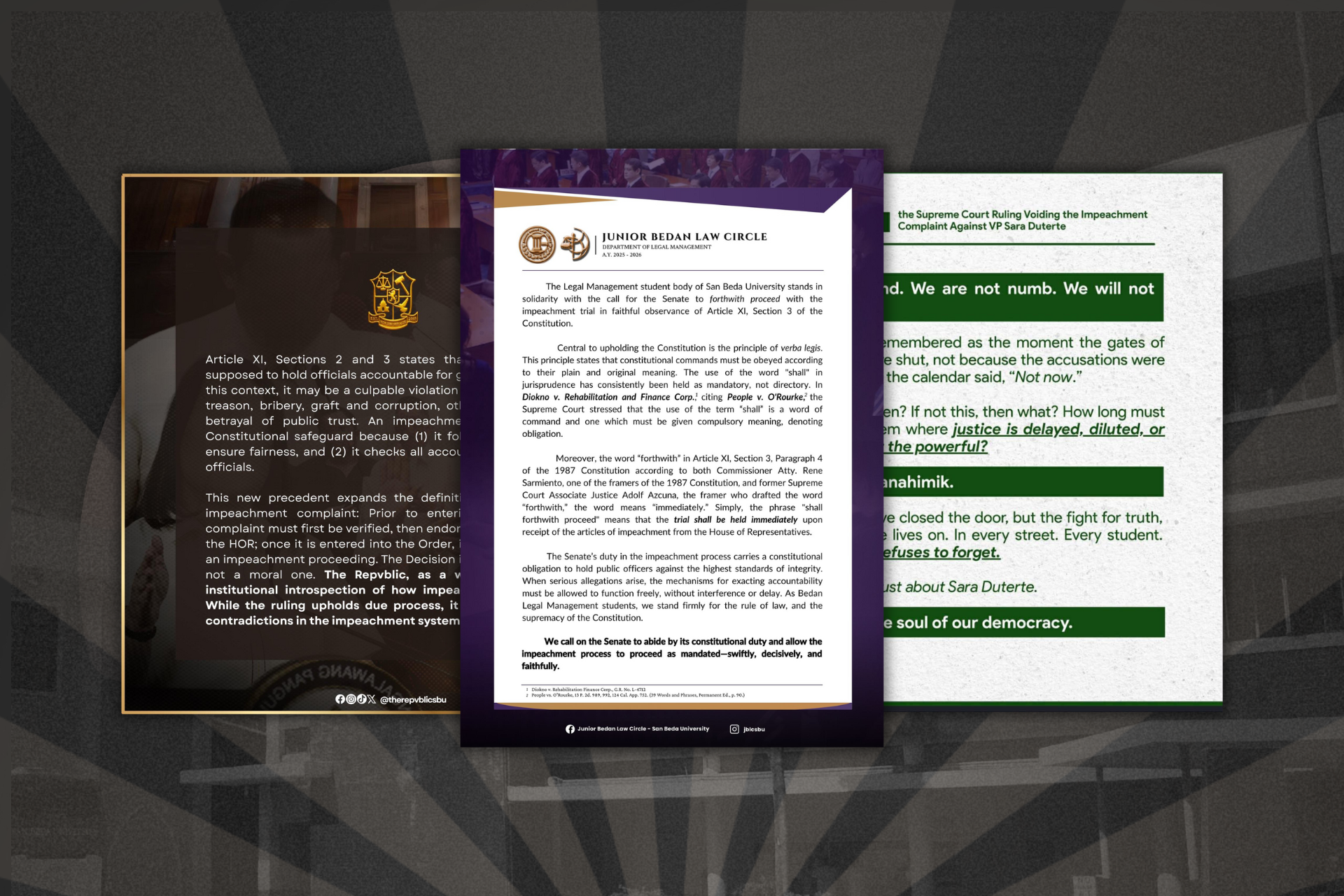
In response, three organizations from the SOC have released separate statements addressing the implications of the verdict.
The Junior Bedan Law Circle (JBLC), the professional organization of the Department of Legal Management, issued a statement as early as June 9, after the House transmitted the Articles of Impeachment to the Senate.
JBLC called on the Senate to comply with Article XI, Section 3 (4) of the Constitution and continue “forthwith” with the trial.
In an interview, JBLC President Denise Diaz reiterated the role of student organizations as platforms for engaging the youth in nation-building.
“Emerging leaders of our nation are among our numbers; developing a generational mindset that upholds justice and accountability would definitely plant the seeds of change to be reaped in the near future,” Diaz emphasized.
In their statement, the organization also emphasized that the terms “shall” and “forthwith” hold mandatory legal weight, asserting that mechanisms for accountability must operate without interference. “The Constitution is clear. It is not a matter of discretion—it is a duty,” its statement read.
Following the Court’s decision, the Bedan Awareness and Consciousness Enhancement Society (BACES), an accredited socio-civic organization of SBU, released a statement on July 27, describing the ruling as a “concerning precedent.”
In its post, BACES stressed that the decision put forth procedural compliance over the pursuit of truth, warning that legal technicalities should not be used to “shield” public officials from scrutiny.
“This is a national concern—so no matter who you are, you should care. Hindi lang ito laban ng mga estudyante. Hindi lang tungkulin ng mga student orgs tulad ng BACES ang makialam. Lahat tayo may pananagutan,” BACES President Reuben de Leon told The Bedan.
The organization also highlighted that while the Court emphasized that accountability may still be pursued after February 6, 2026, this delay may demoralize further political will and “undermine public trust in the institutions meant to protect the people’s interests.”
Likewise, The Repvblic (TR), the professional organization of the Department of Political Science, aired grievances over the potential “misuse” of legal safeguards in the impeachment process.
The organization expressed that such legal protection, such as the one-year bar, though constitutional, may be strategically invoked to block substantive investigations, and may be “weaponized to preempt legitimate complaints through weak or premature filings.”
“If the time comes na merong impeachable officer, puwede akong mag-file ng impeachment sa sarili ko tapos ipa-file ko siya sa mga kawani ko sa House of Representatives and it will already trigger the one-year bar rule kahit sobrang hina niya lang,” TR President Lee Saltore said.
The group stressed the youth’s role in staying engaged in national issues, stating that “accountability is an essence in democracy.” It also called for reforms and clearer definitions of legal terms like “initiation” and standards for assessing the substance of impeachment complaints.
Recognizing this decision, the Senate has since moved to archive Duterte’s articles of impeachment last August 6, with the chances of trial now hinging on a possible reversal of the July 25 decision.