
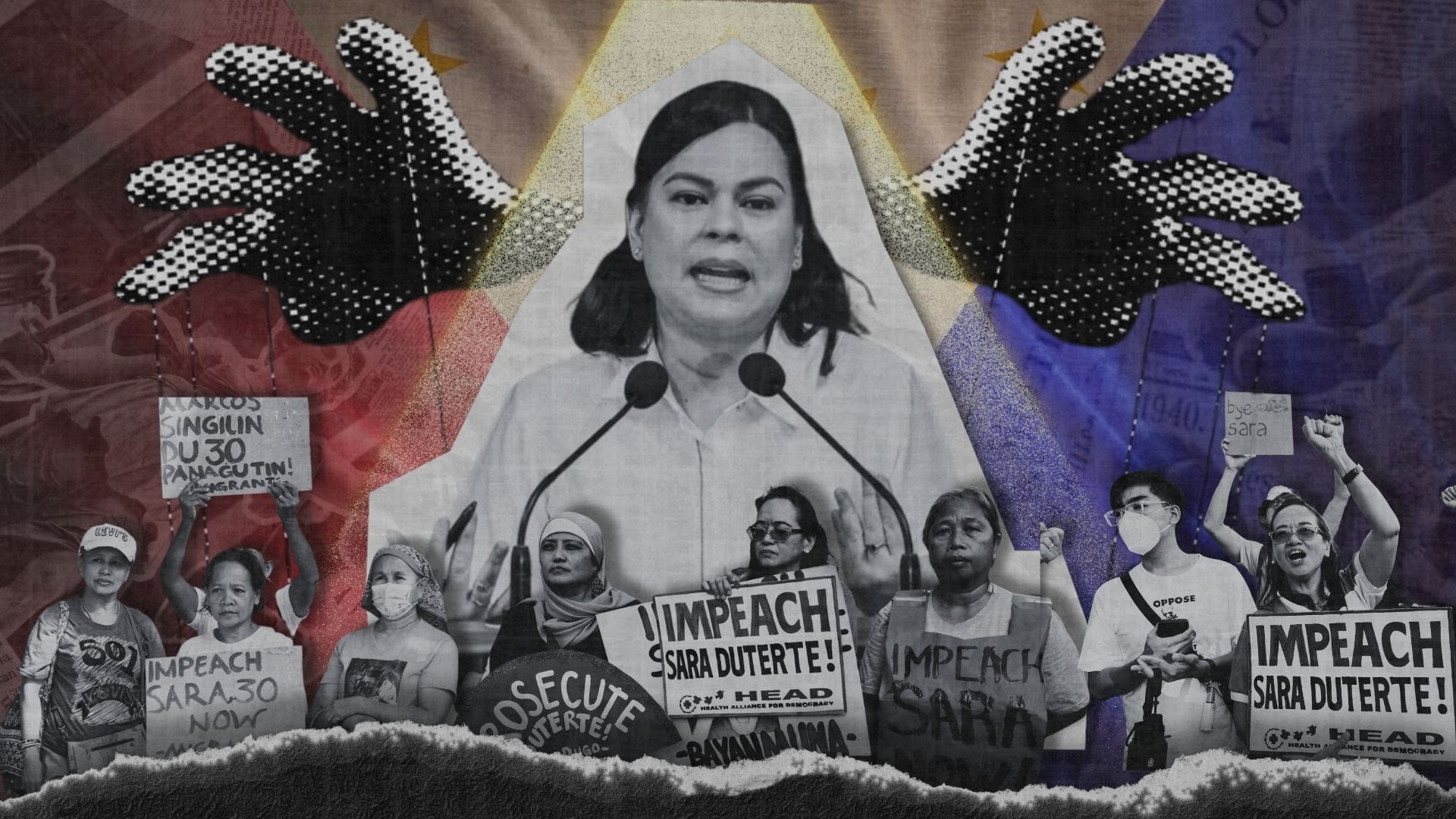
AMIDST THE COMPLEXITIES of the impeachment saga surrounding Vice President Sara Duterte, voices rise and fall across the nation, echoing concerns of power misuse, accountability, and breach of public trust that have sparked a widespread reflection on the implications of such a political process within the Philippines’ democratic landscape.
The House of Representatives’ impeachment complaint against the Vice President was declared barred by the Constitutional rule against impeachment proceedings initiated against the same official more than once within a year, which was meant to uphold due process and lend impartiality to the impeachment proceedings.
As the national controversy swelled, the recent Supreme Court (SC) ruling on the case left many in disbelief.
In an interview with The Bedan, students voiced their opinions on the recent SC ruling, arguing for an affirmation of constitutional order and seeing this moment as perhaps ill-suited for an impeachment to move forward, yet acknowledging that such a course of action may ultimately find its way to realization in the nation’s political stage.
Inside the mind of the Court’s verdict
As the 19th congress drew to a close, the SC decision on the impeachment continues to stir conversations across the country.
On August 6, 2025, with the 20th congress already presiding, the Senate voted on whether to archive the Articles of Impeachment against the Vice President. 19 senators voted in favor of archiving the complaint, four voted against it, while one abstained.
People from all walks of life have also voiced differing opinions and critiques, reflecting the deep divisions and varied perspectives surrounding the matter.
Angelo Lobo, a junior from the Department of Legal Management said,, “I think we should of course respect the ruling by the Supreme Court because the Supreme Court doesn’t exercise its superiority towards the other co-equal branches of government, but so upholds the Constitution, the supremacy of the Constitution.”
While some have resolved to accept the decision, others cling to the hope that it may still be overturned.
Vincent Mira, a third-year Political Science student, expressed mixed feelings. “If ang tanong ay what do I feel about it, I feel hopeful kahit papaano for a reconsideration from the Supreme Court,” he expressed.
Authoritative influence over sovereignty
The juxtaposed perspectives on the SC ruling over the impeachment reflect not only a clash of public sentiment but also its potential influence on the sovereignty of the nation’s democratic institutions.
“Some people have no idea what happened, and I think it will really confuse them out. Maybe this decision will result in apathy among some people na hindi ko naman naiintindihan yung kaso, bat pa ako makikialam,” Lobo reiterated.
His statement points to the concern that without sufficient public understanding of the case against VP Duterte, individuals may either fall for rhetoric or be blinded by her persuasive political image, creating an impression shrouded in illusion and ultimately affecting the gullibility of democratic processes.
“We found out that the Filipinos lean onto authoritarian political personalities as a catharsis to this systemic hypocrisy that democracy has been bringing to the Philippines,” said Mira, emphasizing the recurring political pattern in Philippine politics. He then continued to shed light on how the choices made today may ripple into the nation’s future.
Weighing justice and accountability
In its decisive ruling, the SC halted the impeachment proceedings against the Vice President, ruling that essential procedural safeguards were ignored by the lower house. Declaring such allegations as inadmissible, the Court barred the impeachment proceedings until February 2026, signalling a legal pause rather than a political conclusion.
Reflecting on such a decision, Lobo has also expressed the imperative nature of accountability hovering over constitutional procedures.
“Maybe tama na hindi na afford ng due process si VP Sara, but we should remember that due process is about protecting a person who is to be deprived of life, liberty and property. Public office isn’t property, is it? It’s not liberty. So, it’s also about the accountability of public officers,” he said.
As sovereignty loses its grip to restrain the state regarding the issue, Mira argued that the impeachment process should not be delayed indefinitely.
“Impeachment is not a criminal case where you apply all the strict bill of rights process requirements, because ‘yung public office after all ay hindi siya private property. You don’t ‘own’ it the way you own a house or a car, hinahawakan mo lang siya by virtue of entrusting which is emanating from the people,” Mira stated.
This argument on accountability reconciles both conversational discourses and constitutional debates. Retired SC Associate Justice Adolf Azcuna, one of the framers of the 1987 Constitution, summed it up powerfully, in his remark that “the principal casualty is the actual accountability.”
This stark statement points to a deeper truth that the Vice President has become the focal point of the controversy, with the alleged violations forming the core argument for why impeachment proceedings are now being pushed forward.
Considering such democratic crossroads, we are faced with parallel dilemmas–to prioritize constitutional safeguards or rightfully demand substantive accountability as sovereign Filipino citizens, or to value stability in institutions or insist on reckoning with public officers’ alleged abuse of power.
Students, like Mira and Lobo, grapple with these tensions not as distant spectators but as participants in a nation where democratic promises collide with entrenched political compromises. Such voices echo the frustrations of a generation caught between reverence of the law and the genuine ache for accountability.
When accountability becomes the “principal casualty,” public trust will reek of fragility, creating a stigma that risks erosion. We must take in mind that for democracy to rule and endure, it must not only uphold technicalities but also nurture vigilance among its citizens—because the true power of democratic sovereignty lies not in the courts alone, but in the people’s resolve to demand integrity from those in power.
(with Asher Ugaddan)