
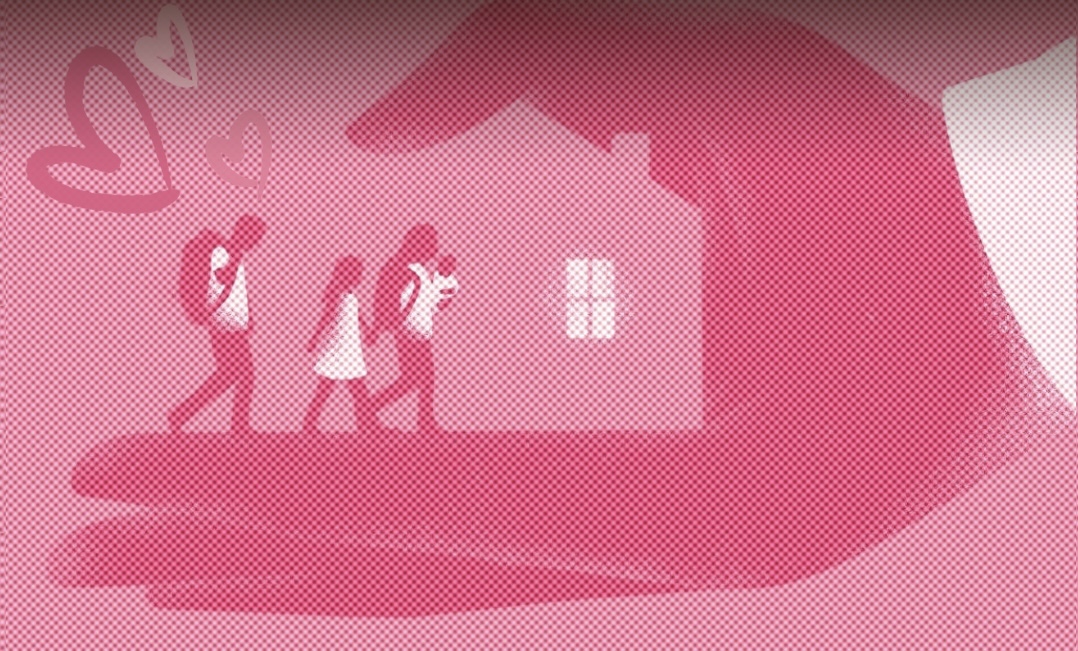
WHEN ONE LEARNS love, it most often begins at home, found in the unwavering support of parents, in quiet routines with family, and simply in their presence itself. Thus, the love nurtured at home carries the foundation on how individuals treat themselves and the world around them.
With this, The Bedan sought the perspective of the Bedan community on how their upbringing at home shaped their view on love.
On warmth and support
On difficult days, home is often the first place people turn to for solace and comfort. For Department of Psychology freshman Jaymee Moncawe, love is rooted in the unwavering support of her parents.
“My mom shows me their love by taking care of me-cleaning and cooking for me and my father; he likes talking to me whenever he notices that I have problems,” she recalled.
She reflected that this influenced her perception of love, which she continues to apply when forming new relationships today.
“They showed me that it’s about supporting someone you love, being there for them, and loving them exceptionally again,” she reflected, adding that “…their love for me overflows so that I can share it [with] other people.”
At last, when a person like Moncawe is raised in a loving home, its effects overflow— from the way they treat their peers up to the way they see love. Thus, it creates a kind of notion that a person raised with love is one who is secure in themselves.
Love in silent corners
Sometimes, love is seen in familiar places-in the mundane moments of life. For Odette Caraang, a Department of Legal Management sophomore, it lives in the smallest gestures of her family-from remembering small details, checking in on her, and looking after her even on normal days.
“My family is very loving. They are always supportive of my choices, and they always try to know what’s going on with my life and check up on me every time I’m in Manila because they’re from llocos,” she recalled.
Although her family does not usually celebrate Valentine’s Day, she remembered a time when she showed her vulnerable side to them. This remains a testament to how her family’s love is grounded in quiet gestures and understanding.
“Sina Mama, always nilang natatandaan yung mga little things na nasabi ko…Parang pag may nirarant ulit ako parang cinoconnect nila vung mga nararanasan ko noon na na kwento ko na sa kanila,” she said.
For Odette, she believes that this shaped her perception of love, as seen in small gestures of showing up and checking up on people close to her.
“It’s not always the grand gifts that are the most important when it comes to love. It’s more [about] how you hold your friends, how you treat them on a regular basis,” she emphasized.
With this, she sees to it that one’s upbringing plays a pivotal role in shaping their notion of love, saying, “Kasi yung love na nakasanayan mo noong bata ka, yun na ‘yung... most of the time babalik balikan mo.”
From her family’s approach, she learned that silent treatment is not a way to resolve misunderstandings.
“I really learned something from that kasi it’s not a good conflict resolution kasi sometimes kailangan mapag-usaran yung mga conflicts…para hindi na maulit yung conflict na ganun,” she stated.
In finality, Odette sees that love is not found in the grandest of things. It is found in the silent corners of presence, understanding, care, and communication; a reminder instilled in her growing up.
A two-way street
In the four corners of his home, Neil Macalindong, a Department of Political Science junior, finds love in the chaos of his household. When asked to describe his family, Neil jokingly reveals, “It’s a typical toxic Filipino family, pero bearable.”
While conflicts and rifts between the members are not uncommon, he shared that love, for him, lies in the bond that continually makes him choose his family over and over again.
This bond becomes most evident in moments when they are together in unfamiliar places, particularly during family trips where it is just the six of them. In these trips, far from their usual routines and comfort zones, he proves that love isn’t in the absence of conflicts but in the choice of showing up for one another.
Love, in Neil’s household, is often expressed through quality time and gift-giving.
“Medyo inconsistent, pero we usually go out sa restaurant and binibigyan namin ng flowers si Mame. ‘Di nawawala yung surprise sa midnight ng flowers and chocolates,” he shared.
For Neil, these gestures matter less for their consistency and more for the care and effort behind them.
Through these experiences, Neil observes that love does not solely rely on the efforts of one person; it’s something they all actively give and share. He has come to see love as a “two-way street.”
“Cheesy na naman, pero love is really a two-way street!” he quipped
Conflict, too, has taught him lessons about love. “Di ko recommended yung silent treatment… mas maigi talaga na mag-usap, try to understand each other, and mag-compromise,” Neil reflected.
For him, love is not just gestures or gifts. It is in showing up, communicating, and choosing to understand one another, even in the messy, unpredictable moments of family life.
Love, he realizes, is not about perfection; it’s about showing up, repeatedly, for the people who matter most.
Family plays an important role in how a person views love. It is something that they carry growing up-especially in giving and receiving it. Throughout one’s formative years, it influences their capability to form genuine connections with people, ways to handle conflicts, and express affection to others.
Yet, there are also times when the love learned from family is found in the quiet ache of learning, unlearning, and relearning what love is. Despite this, it is without a doubt that love from family serves as the blueprint for the love a person carries into the world.
(with Andrea Dominique Romero)