
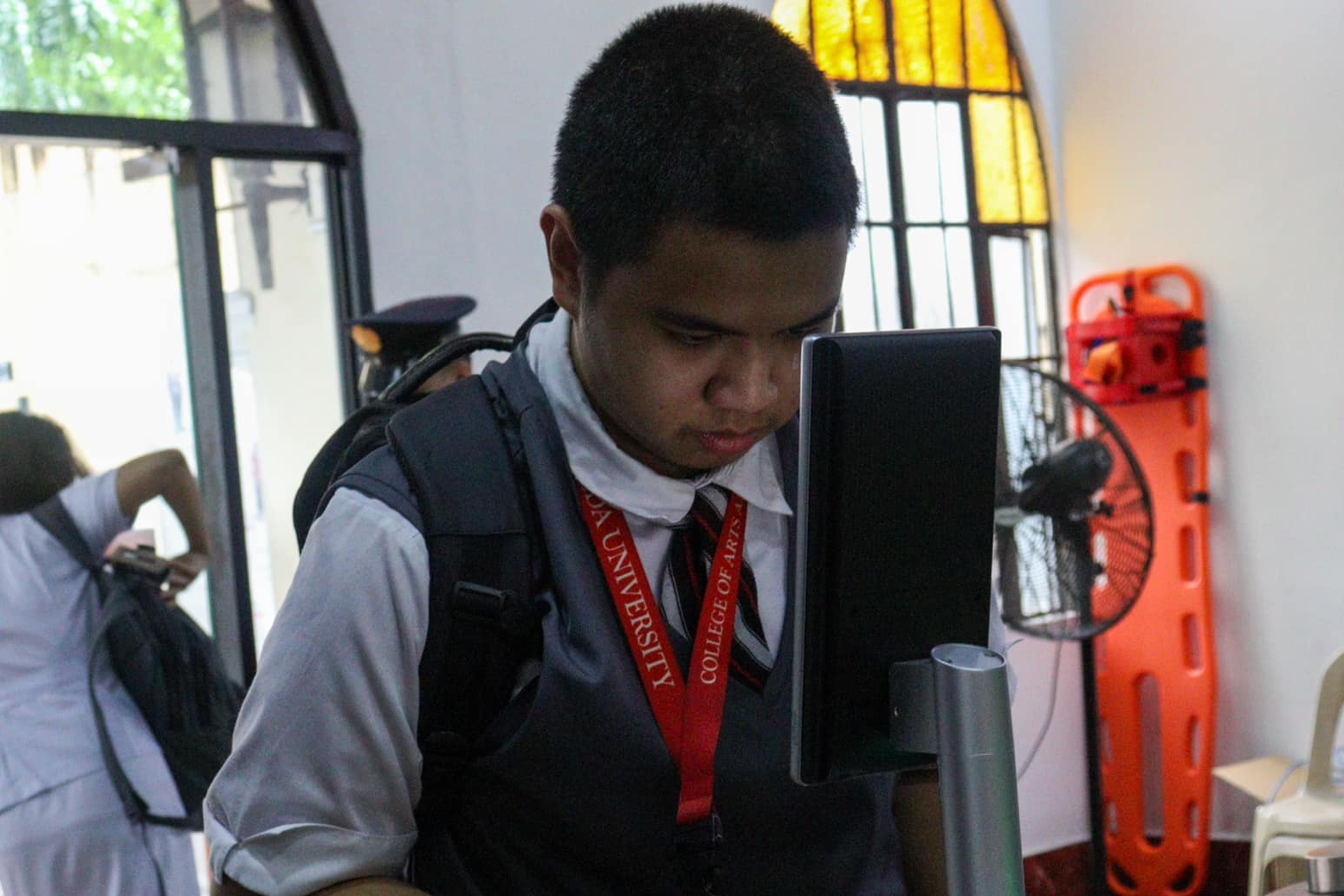
TO ENSURE AN “efficient and reliable means of security and attendance system,” the Information and Communications Technology Center (ICTC), in partnership with the Vice President Administrative Board, installed a facial recognition feature to the security systems at the entrance and exit gates of the San Beda University (SBU) Manila campus, made accessible to the students and personnel at the beginning of the Academic Year (A.Y.) 2024 to 2025.
Debuting its functionality last September, students and staff were no longer required to have their Identification card (ID) scanned upon entering and exiting the campus premises, since the facial recognition system would immediately scan the person’s face as they come close to the designated screens.
Ms. Barbara Ann Yanga, Information Technology (IT) Development and Services Office Head, shared that “the San Beda University face access and attendance system has a range of features and security measures that may enhance campus operations.” Its development came about to “aid both the security and attendance-monitoring aspects of the school’s operations.”
As for the attendance-monitoring front, the developed system was discussed to have used advanced algorithms for facial recognition, “allowing for accurate and rapid identification while supporting a seamless, contactless access control experience,” as stated by Ms. Yanga.
The “versatility” of the system was on full-time display as it “provided real-time monitoring, delivering live data on attendance for immediate verification and reporting.” On the management’s side, it also offers a “user-friendly interface” which makes it “more convenient” for the system administrators to navigate, streamlining operation and management.
With the privacy of the data being stored, Ms. Yanga assured that several strong measures were implemented to comply with the protection of the user data, specifically its data encryption ensuring that all biometric information being collected is safeguarded against unauthorized access.
“Additionally, the anti-spoofing technology enhances reliability by detecting and preventing attempts to deceive the system using photos or videos,” she added.
She then revealed that during the process of its implementation, they were met with the challenge on the technical side, centered on the “network configuration.” She expressed that, considering how “it is vital to establish secure and stable networks in successfully implementing the system,” they have adjusted the University’s IT infrastructure.
“Additionally, the user enrollment process presented its own challenges, particularly in collecting and securely storing the biometric data of all employees and students,” added Ms. Yanga.
Nonetheless, they were able to execute the system carefully to “ensure accuracy and privacy and achieve smooth implementation.” She further regarded the new face access and attendance system as “more effective” in comparison with the traditional ID scanning system because of its “speed, accuracy, and contactless operation,” reducing waiting time and risk of human error while allowing “quick entry without physical contact.”
To conclude, Ms. Yanga underscored the importance of implementing such facial recognition system not just in convenience, saying “This transition not only enhances efficiency but also strengthens security across the campus, contributing to a smoother experience for everyone at San Beda University.”