
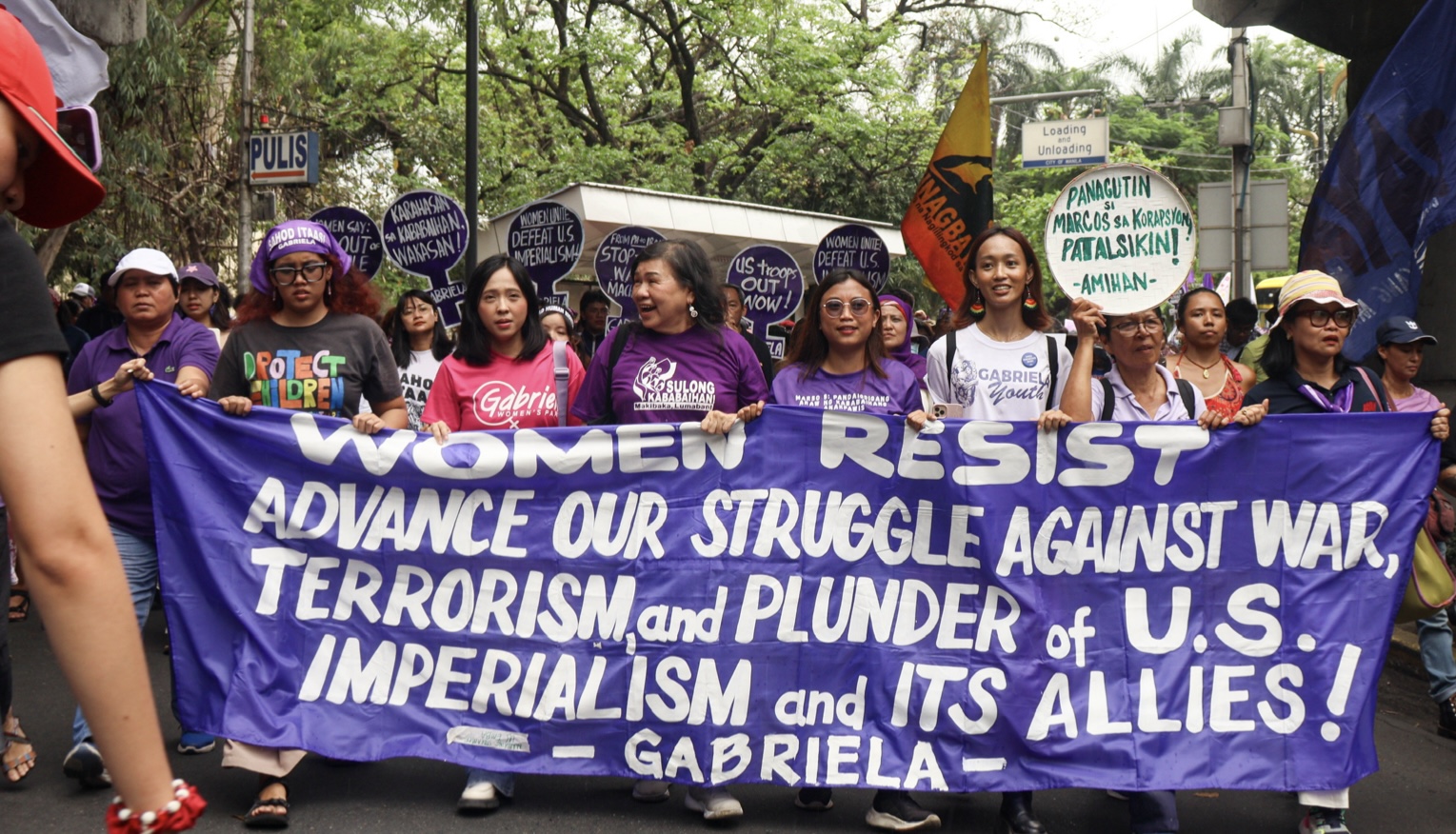
CELEBRATING INTERNATIONAL WORKING women’s day, thousands of individuals from various sectors flooded Liwasang Bonifacio with a powerful protest against the country’s deepening economic and political crises and culture of misogyny last March 8.
Representatives from labor, youth, urban poor, and cultural sectors converged as part of the nationwide commemoration of International Working Women’s Day to amplify the calls for structural reforms that addressed the everyday struggles of Filipinos, especially women.
This mobilization was spearheaded by groups including Gabriela Women’s Party, KADAMAY, Sining Lila, and Bagong Alyansang Makabayan (BAYAN) to pin their voices on concrete issues affecting Filipino women, including the continued rise in food and transportation costs, low and contractual wages faced by many workers, the lack of accessible healthcare and childcare services, and persistent cases of gender-based violence and harassment in workplaces and communities.
Speakers also criticized policies that worsened economic hardship, such as taxes on basic goods and insufficient social assistance for low-income families.
The protest highlighted a growing indignation toward the “macho-fascist” culture within the government, specifically citing recent derogatory remarks made by politicians such as Quezon City Representative Bong Suntay, against female personas.
Protesters argued that these incidents were not “isolated gaffes” but “symptoms of a government ruled by leaders who weaponized misogyny,” emphasizing that this kind of leadership was the driving force behind a broken system where the poor were left to suffer while those in power remained unaccountable.
Cultural worker Nathalie Geralde of the group Sining Lila, who was recently subjected to body shaming on online platforms during the September 21 protest, strongly condemned the lack of action on these issues, while simultaneously calling for economic justice.
“Sining Lila kasama ang Gabriela at ang women sector ay pinapanawagan na tanggalin ang VAT or value-added tax or ang 12% na kinukuha sa mga serbisyo at konsumo natin kasi kasalukuyan nabubulsa lang naman ng mga kurakot,” she said.
Peasant sector organizer and student leader Amanda Echanis added that the ongoing social and economic crises are affecting households across the country, citing issues such as taxation, corruption, human rights violations, and gender-based discrimination in politics.
“Hindi naman hiwalay ‘yung laban ng mga kababaihan sa laban ng mas malawak na sambayanan,” she asserted.
Echanis also stressed the importance of women’s collective action in responding to these challenges, as she conveyed that the struggle for women’s rights is closely linked to broader societal struggles, and that their voices contribute to a unified call for justice and accountability.
Congresswoman Sarah Elago of the Gabriela Women’s Party discussed the impact of the global situation on the local economy, particularly the conflict in the Middle East which had caused oil prices to skyrocket, adding to the increasing social dilemma faced by the country and women.
According to Elago, one of the most urgent concerns raised during the protest was the continuous rise in the prices of basic commodities.“Number one is the high prices of food and goods, exacerbated by the skyrocketing prices of oil and petroleum products,” she said.
Elago also criticized the country’s tax system, arguing that the burden fell heavily on ordinary Filipinos.
“Ang VAT kasi ‘yan ay isang consumption tax—mayaman ka, mahirap, may trabaho ka, wala—lahat tayo affected. Kaya mas mabigat ‘yan para sa mga mahihirap at dapat nang tanggalin,” she added to accentuate the demands of progressive groups for tax reforms that would ease the economic strain on low-income families.
Furthermore, Elago stressed that achieving a fairer and more just present and future requires persistent effort, but assured the youth that they are not alone in this struggle and urged the people to keep organizing and advocating for women’s rights and social justice.
Following the program at Liwasang Bonifacio, demonstrators set out on a march toward the United States (US) Embassy in Manila to press their demands for wage increases, the removal of burdensome taxes on basic goods, and stronger government action against gender‑based violence.
As the crowd moved along Kalaw Avenue toward Roxas Boulevard, Manila Police District (MPD) officers established a barricade that blocked the group’s advance and prevented them from reaching the embassy grounds.
Despite the blockade, the rally remained orderly and peaceful, with protesters maintaining their chants and calls for social and economic reforms, determined to commit to their fight for policies and government systems that uphold the dignity, safety, and rights of Filipino women.
(with Eunice Karen M. Buccat)